Jekyll2025-02-20T00:42:04-08:00https://stedmanhalliday.com/feed.xmlStedman HallidayStedman Halliday is a technical generalist based in San Francisco creating values-aligned products, brands, media, and experiences.Stedman Halliday7 Songs: Feb 20252025-02-19T00:00:00-08:002025-02-19T00:00:00-08:00https://stedmanhalliday.com/blog/2025/02/19/7-songs-feb-2025KID AGAIN—Jon Bellion
A friend put me onto this track back in November after hearing my guitar noodling reminded him of the intro loop and it hasn’t left my rotation for long since. Jon Bellion’s triumphant return with a first solo track in six years is equal parts melodic and aggressive, with a driving energy that reminds me what it’s like to keep trying to get back to the feeling of being a kid again, cooking things up in my bedroom.
Red Synthetic—Zhone
My second pick of the month isn’t a new track, but I come back to Zhone’s Red Synthetic frequently. Sonically, there’s a ton to appreciate about it: huge, cinematic dynamics and sound design and that moment just past the halfway mark where the filter EQ sweeps down on the vocal refrain to yield something like a vocoder synth. This track’s release notably calls forth the spirit of this post series: music discovery through the lens of first-person experience. There’s something special about the way online music discovery in particular evolved over the decade leading up to this release in 2021. I used to usually discover music online through the blogosphere, but by the height of the pandemic, I found myself in niche online communities communicating and collaborating with artists, sharing work in its early stages.
I first heard this track when Zhone shared a pre-release version in Outskrrts, an online community that broke out of Yung Skrrt’s Twitch stream during the pandemic to organize events like stream pregames, afterparty raves, and artist showcases, all over Zoom. The release later found a home on Vol. 4 (LOVE) of the Mutants Mixtape series of benefit compilations, themselves a product of a niche online community of artists: the Mutants1000000 Discord launched by Arca right as the world went into lockdown in March of 2020. I cherish the special connections that are still in my life from my time in these communities and hold sacred the opportunity to observe artists’ nascent work as they share stories behind it.
Blue Hour—Nosaj Thing feat. Julianna Barwick
A couple of months ago, I caught a special performance featuring Nosaj Thing at the Audrey Irmas Pavilion in Koreatown. The venue itself is a marvel—geometric and imposing, yet somehow inviting, like a monument to the modern. The night was a layered experience: an exhibition upstairs featuring art and technology experiments, followed by Flux, a collaboration between Kevin Peter He and Jake Oleson that blended live music with real-time 3D cinematics and dynamic camera work. It was a fluid, maximalist vision of what’s possible at the intersection of sound and image.
Afterward, Nosaj Thing took the stage, framed by simple film projections—subtle, restrained, evocative. After the hypermodern spectacle of Flux, his set felt like a meditation, pulling attention toward nostalgia rather than novelty. Blue Hour in particular hit me in that way—like something slipping through my fingers, a fleeting warmth held just long enough to feel its absence. The visuals accompanying it had a liminal, in-between quality—scenes that could be anywhere and nowhere, the kind of images that bring to mind times caught in the cracks of a city, existing but untethered, anonymous in the early hours of the morning.
Watching Nosaj Thing in LA again some 15 years after first seeing him perform at Low End Theory was a full-circle moment. That era still lingers in my head like a half-remembered dream… and that’s exactly what the city looked like as I stepped outside into the rainy night to find some casein.
Curves—Ivy Lab
Curves by Ivy Lab also feels like a transmission from the late aughts LA Beat Scene: Low End Theory, Shlohmo, the WEDIDIT crew, etc. The track vibes in a lush space between ambient ethereality and club weight, where textures stretch and morph into something atmospheric and trip-hop sensibilities meet sculpted bass design. This sound isn’t terribly new anymore, but here it seems to remain pure as a hypnotic loop bending time around its pulses. It’s a solid reminder of similar sounds from the past, still echoing and resonating.
Fellow Traveler—Fucked Up
Fellow Traveler kicks off with a reversing tape loop that winds back time just before the a wildly distorted riff tears through the mix. The call-and-response vocals layer in tasteful harmonies that offer a kind of rough singsong quality. It’s a song with driving force that never stops moving, bursting with a restless, youthful energy that makes me want to run outside and keep running until the last note fades.
Subversion (Brand New Love)—Touché Amoré feat. Lou Barlow
The guys in Touché are approaching (if not already within) their middle age years (frontman Jeremy Bolm now boasts 41 years of age). That’s a sobering realization. I’m not quite there yet myself, but it’s been more than half my lifetime since I started watching them play small rooms in LA and I won’t lie, I’m starting to feel the clock. What better opportunity to interpolate Sebadoh’s Brand New Love—a song about cautious hope and openness to something new (anyone could be a brand new love)—alongside original lyricist Lou Barlow. Bolm’s refrain says it best:
I can’t see Beyond the Years behind me And it’s staggering
Bourbon—Gallant
Earlier this month, I had the chance to see Gallant perform at the Independent in San Francisco on tour for his latest release Zinc. His always stellar performance made for a fun show where I ran into old friends and made some new ones. Some fans I chatted with expressed a lingering preference for his debut album, Ology (2016), over the newer material (a sentiment I share). While I hope that the soaring falsettos and anthemic delivery on Bourbon gave those fans what they were looking for, I found a lot of appreciation for how the live band instrumentation added dimension to Gallant’s newer material. It was a good reminder that making room for what’s new sometimes means loosening one’s hold on the past—trust the detox.
If you’ve read this far (thanks), you probably like music quite a lot.
Message me on X (Twitter) if you’d like to get some 🏓 Playlist Ping Pong going or chat about music.
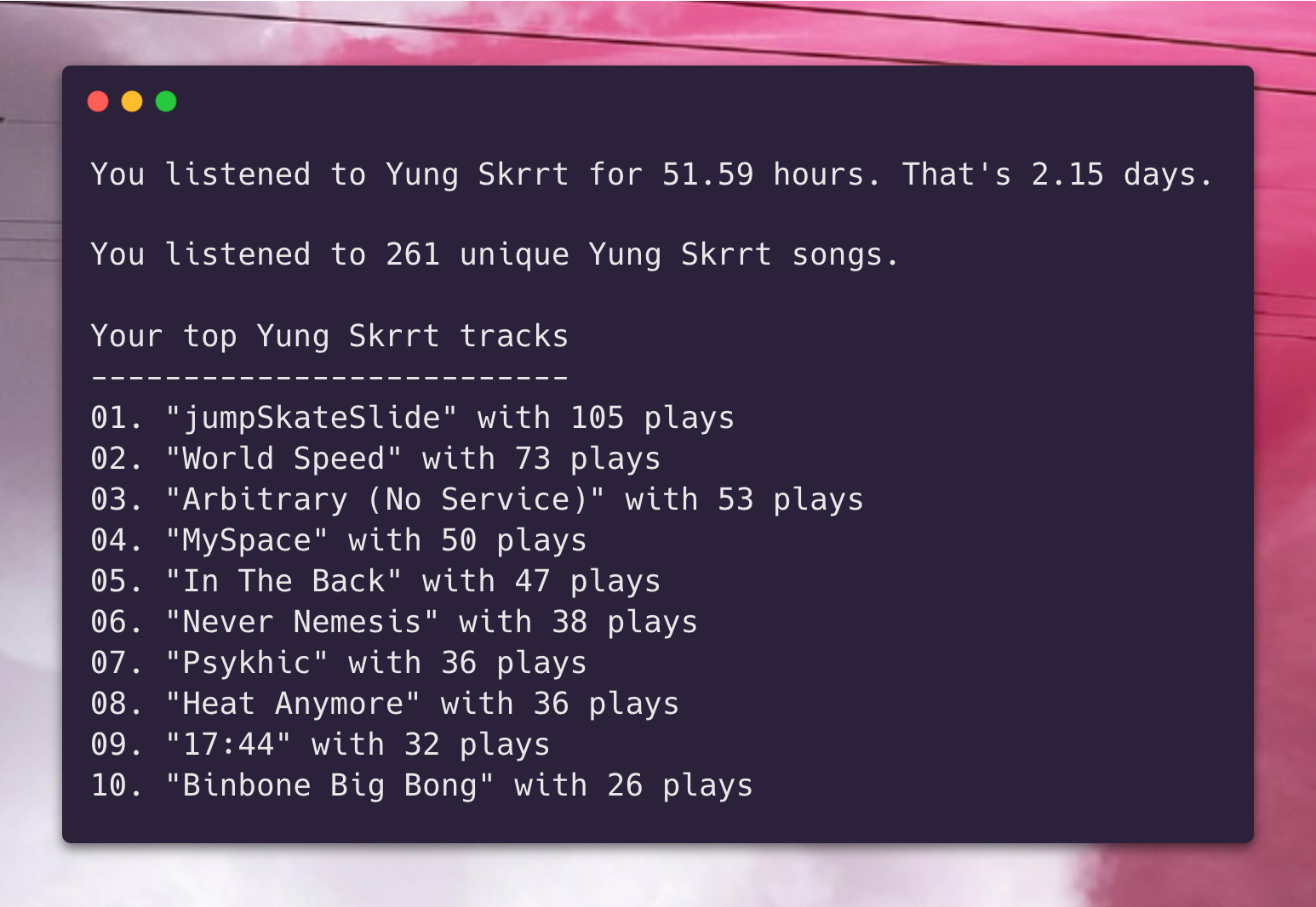
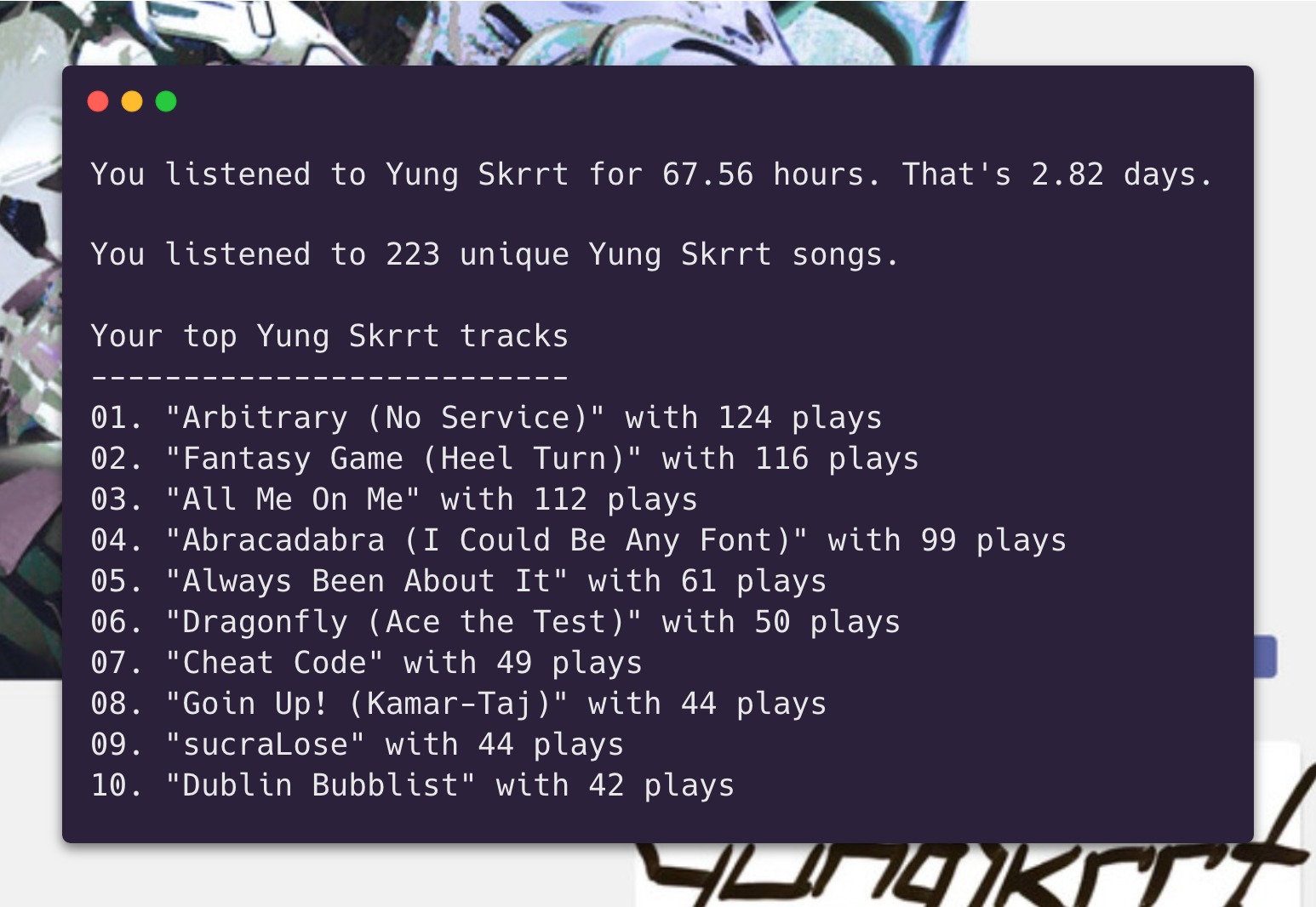
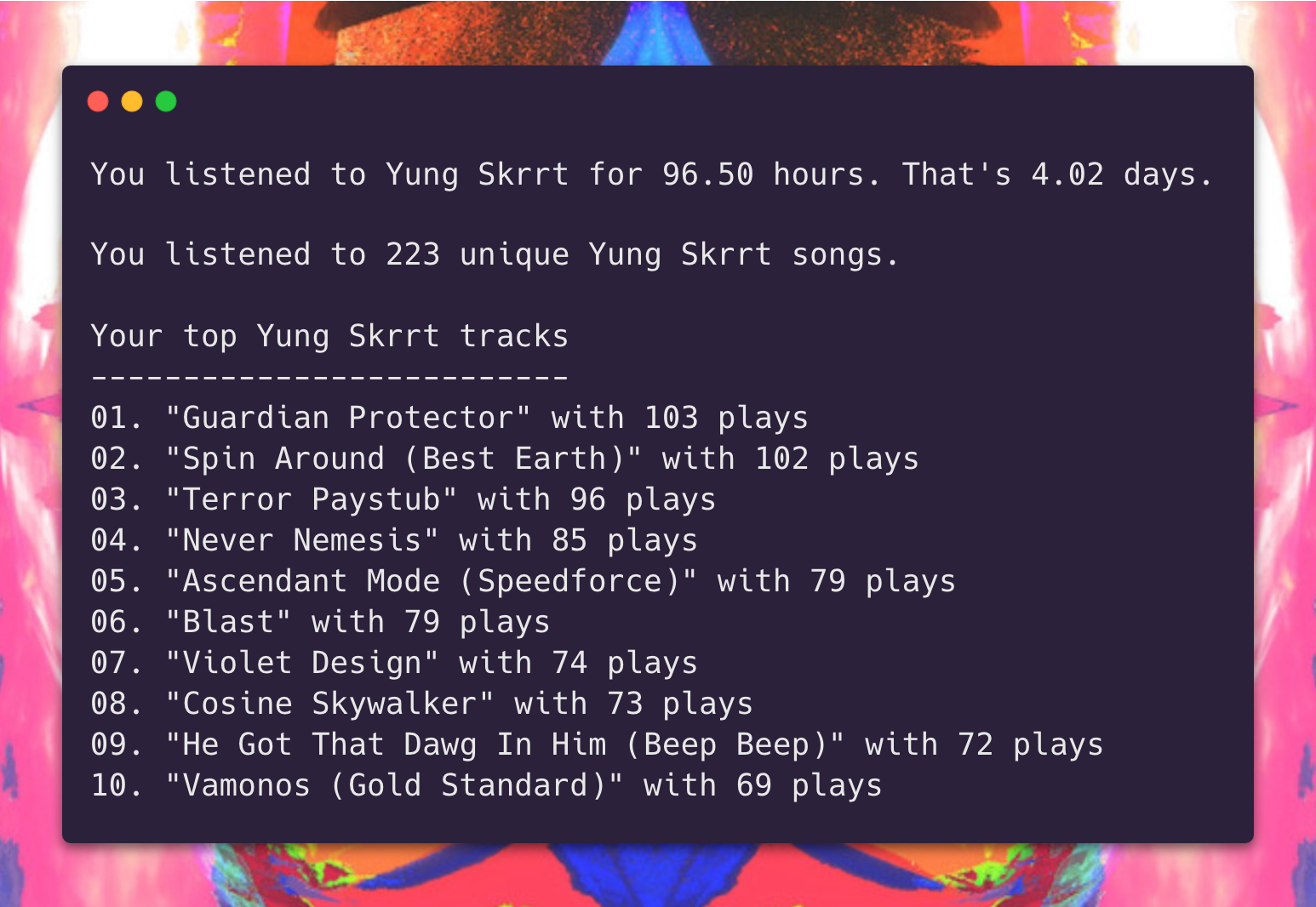
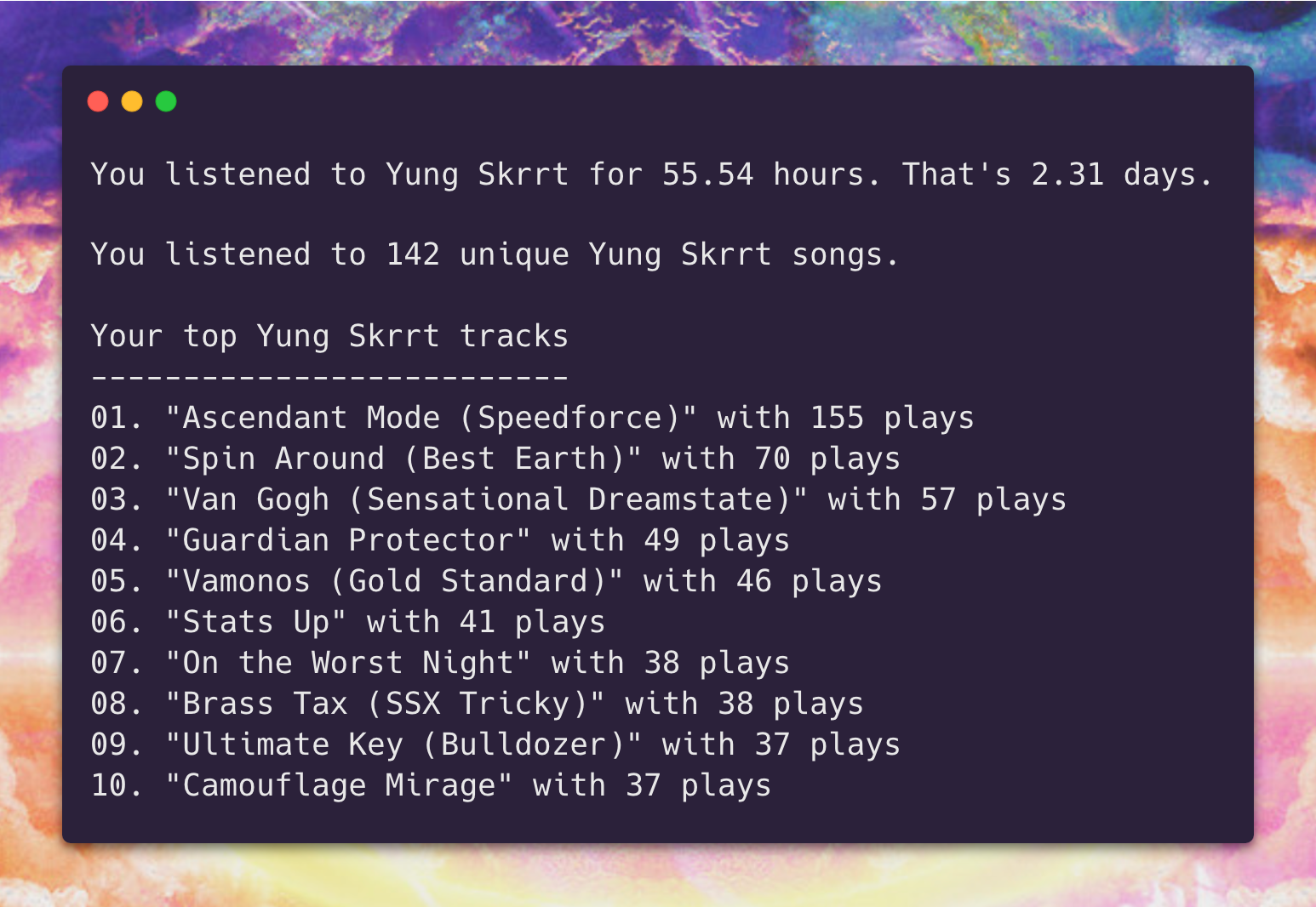
]]>Stedman HallidayskrrtStats 2021–20242025-02-12T00:00:00-08:002025-02-12T00:00:00-08:00https://stedmanhalliday.com/blog/2025/02/12/skrrtstats-2021-2024I am undeniably a Yung Skrrt superfan. There is something (several specific things, actually) about his music that triggers a deep fixation in me with roots as low as the limbic tier. I’ll write a blog post about them someday in honor of the Gimbus GOAT King of Internet Music.
For now, I’ll collate annual analytics for my Yung Skrrt streaming data which I’ve been collecting for four years running. I’ll also share my code so you can generate insights from your own Spotify streaming data for your favorite artists.
skrrtStats 2024
51.59 listening hours (2.15 days) for 261 unique tracks
skrrtStats 2023
67.56 listening hours (2.82 days) for 223 unique tracks
skrrtStats 2022
96.50 listening hours (4.02 days) for 223 unique tracks
skrrtStats 2021
55.54 listening hours (2.31 days) for 142 unique tracks
Generate your own insights
Generate insights for any artist of your choice from your own Spotify streaming data. Here’s how:
Visit the Spotify Account privacy page and log in
Request a copy of your personal data with the Download your data tool
Use the normal option, not Extended streaming history
It will take some time for Spotify to process your data and email you back with a download link
Download and unarchive your data
Download code from this gist, or copy it to a new file from the block below
Place the script file in the same directory as the unarchived data folder (Spotify Account Data)
Edit the constants up top for the artist and number of top tracks you’d like to output
Run the script from the command line with Node.js or an equivalent JavaScript runtime environment
Bonus: use Carbon to generate cool snapshots of your stats like the ones I’ve featured in this post
constARTIST="Yung Skrrt";// substitute any artist (ensure exact match)constTOP_TRACKS=10;// number of top trackx to display// time conversion constantsconstMS_IN_HR=3600000;constHRS_IN_DAY=24;// GOTTA HIT THE STORAGE SPOT, GET UP IN THE STASH!// retreive and consolidate streaming dataconststreams0=require("./Spotify Account Data/StreamingHistory_music_0.json");conststreams1=require("./Spotify Account Data/StreamingHistory_music_1.json");conststreams=streams0.concat(streams1);// filter to streams of tracks by artistconstartistStreams=streams.filter(stream=>stream.artistName===ARTIST);// return play duration of all artist streams in millisecondsfunctiongetDuration(){letduration=0;artistStreams.forEach(stream=>{duration+=stream.msPlayed;});returnduration;}// return duration in hoursfunctiongetDurationInHours(){return (getDuration()/MS_IN_HR).round();}// return duration in daysfunctiongetDurationInDays(){return (getDuration()/MS_IN_HR/HRS_IN_DAY).round();}// return a sorted (descending) Map<trackName, playCount>functiongetTracksByPlayCount(){consttrackCounts=newMap();artistStreams.forEach(stream=>{if (!trackCounts.has(stream.trackName)){trackCounts.set(stream.trackName,1);}else{letcount=trackCounts.get(stream.trackName);count++;trackCounts.set(stream.trackName,count);}});consttrackRanks=newMap([...trackCounts.entries()].sort((a,b)=>b[1]-a[1]));returntrackRanks;}// return a string listing the first n top tracksfunctionlistTopTracks(){consttrackCounts=getTracksByPlayCount().entries();lettopTracksList="";letrank=1;for (trackoftrackCounts){if (rank>TOP_TRACKS){break;}topTracksList+=String(rank).padStart(2,'0')+". \""+track[0]+"\" with "+track[1]+" plays \n";rank++;}returntopTracksList;}// decimal rounding (to hundredths)Number.prototype.round=function(){constnum=this;return (Math.round(num*100)/100).toFixed(2);}// string formatterString.prototype.format=function(){vars=this,i=arguments.length;while (i--){s=s.replace(newRegExp('\\{'+i+'\\}','gm'),arguments[i]);}returns;};// STATS UP, STATS UP!// print artist statsconsole.log("\n"+"You listened to {0} for {1} hours. That's {2} days. \n".format(ARTIST,getDurationInHours(),getDurationInDays())+"\n"+"You listened to {0} unique {1} songs. \n".format(getTracksByPlayCount().size,ARTIST)+"\n"+"Your top "+ARTIST+" tracks \n"+"--------------------------\n"+listTopTracks()+"\n");
Did you like this post? Do you have thoughts about Yung Skrrt? Wanna show me what your top artist breakdown looks like?
Message me on X (Twitter) and let’s yap about it.
]]>Stedman HallidaySelected Quotes: Feb 20252025-02-03T00:00:00-08:002025-02-03T00:00:00-08:00https://stedmanhalliday.com/blog/2025/02/03/selected-quotesHermann Hesse on not reading
Stand just once at the stage where the stone by the road means as much to you as Goethe and Tolstoy, you will thereafter gain from Goethe, Tolstoy, and all poets infinitely more value, more sap and honey, more affirmation of life and of yourself than ever before.
For the works of Goethe are not Goethe and the volumes of Dostoevsky are not Dostoevsky, they are only an attempt, a dubious and never successful attempt, to conjure up the many-voiced multitudinous world of which he was the central point.
—Hermann Hesse, On Reading Books
Thomas Merton on the yips
When an archer is shooting for nothing he has all his skill. If he shoots for a brass buckle he is already nervous. If he shoots for a prize of gold he goes blind or sees two targets—he is out of his mind. His skill has not changed, but the prize divides him. He cares, he thinks more of winning than of shooting—and the need to win drains him of power.
—Thomas Merton, The Way of Chuang Tzu
Seneca the Younger on true friendship
One who seeks friendship for favorable occasions strips it of all its nobility.
If you consider any man a friend whom you do not trust as you trust yourself, you are mightily mistaken and you do not sufficiently understand what true friendship means… When friendship is settled, you must trust; before friendship is formed, you must pass judgment. Those persons indeed put last first and confound their duties, who… judge a man after they have made him their friend, instead of making him their friend after they have judged him. Ponder for a long time whether you shall admit a given person to your friendship; but when you have decided to admit him, welcome him with all your heart and soul. Speak as boldly with him as with yourself… Regard him as loyal and you will make him loyal.
]]>Stedman Halliday7 Songs: Jan 20252025-01-31T00:00:00-08:002025-01-31T00:00:00-08:00https://stedmanhalliday.com/blog/2025/01/31/7-songsStone Woman Gives Birth To A Child At Night—Mount Eerie
I’ve spent much of autumn’s turn to winter coasting around California in a sedan. I’m surprised at how long it’s taken me to give the roads their fair due with amount of time I’ve lived in California while owning a car. When Mount Eerie’s been on, I’ve found myself stopping more frequently to contemplate whatever’s knocking at the threshold of my attention—a scenic vista or a mundane slice of time. Awareness has taken on a wide range of flavors from slow and viscous to bold, sweeping, and dynamic. It’s an appropriate soundtrack for being present nowhere in particular.
Circles—Thrice
There’s something I truly appreciate about the way many gems from Thrice’s wide-ranging discography allow themselves to be found and sat within time and again. Beggars is one of my favorite records and Circles is a highlight that’s equal parts somber and expansive, with a small measure of twinkling hope. The lyrics characterize humans as intrepid yet futile in our perennial quests to cast ourselves into the dark and build upon what we know despite our ultimate ignorance, blindness, and fallibility. I haven’t watched these guys play in over 10 years (since the last dates of their farewell tour pre-reunion); perhaps it’s time to indulge a little nostalgia.
Hey Listen—Drug Church
Drug Church’s Prude was one of my favorite releases of 2024. It doesn’t break much new ground sonically, but the songs are well written despite their structural and lyrical simplicity. The tracklist is built with vignettes—often crushing ones—of life on the other side of cracks in modern life that many people would rather just pretend aren’t there (along with the people who’ve fallen through them). Hearing Hey Listen reminds me of an unlucky kid I used to get into trouble with when I was running low on luck myself. It makes me feel abruptly anxious and awfully guilty; sapped and resigned to abject cowardice, shame, and disappointment, yet ultimately grateful. It is indeed tough to find an upside, but there’s no hope for luck without the intent to search. Thanks to Carlos Jarquin for listening to me yap about sad shit. Go tell him about a song that means something to you.
Hollywood—Toro y Moi, Benjamin Gibbard
The end of last year saw me falling back into old patterns of landing myself in some total bullshit in Hollywood. Changing—truly and permanently changing—is a tall order. I guess I’m working my way up to it, but it’s really nobody’s business to even try to help me with this stuff anymore. On an entirely separate note, instrumental production is resonating with me here as creative inspiration. I’m sitting on several years’ worth of 8-bar guitar loops that need arrangements to call a home and I had a fun time bringing some field recordings of indigenous chants and my gamelan percussion fiddlings over to a local session with hex_ earlier this month. I need to finish things!
Heavyheart—munro
Leave it to genre-bending Internet music provacateur in chief Yung Skrrt to run with the meme until it gets far enough out of hand to yield an exquisitely curated 27-song compilation release from Tabula Rasa with a complementary merch drop. munro’s track was the stickiest in my rotation, but the gamut covered by the other contributors showcases some really exciting production. 212 BPM. 5/4 time. Super crunched out sounds. Thank you to Drew for the tweet that started it all, and of course Thank You Dream Girl.
had a dream I was at a rave talking to a girl and she told me about a genre called “hit em” that is in 5/4 time at 212 bpm with super crunched out sounds thank you dream girl
Machinedrum’s curatorial efforts on the compilation mentioned above came fresh off the heels of a deluxe LP release. 3FOR82_D3LUX3 brings even more solid cuts to the table than the original release from back in the spring and this track found me again at the right time in life to embed itself deeply in my rotation. It’s been over 10 years since the Vapor City era and somehow this guy is still finding new things to execute very well. I enjoy the range of experimentation in his crossovers into black music. Not everything hits for me—e.g. I don’t dislike the Jesse Boykins III collaborations, but it’s easy to find R&B I’m more fond of. Kane Train with Freddy Gibbs (2020) was a smash by comparison; a definitive step up in Machinedrum’s ability to find a pocket in hip-hop production with vocal features. HEAL (2024) takes that deeper than production and performance into the realm of transcendent emotional appeal. It’s perhaps a tad less instrumentally inventive but still exquisitely arranged, sitting behind the vocal where it needs to yet still placing melodic variation and dynamic highs where they fit best. Stellar and moving vocal performance and message: life is hard… find a way to push through.
Lullaby—TURQUOISEDEATH
I’ve been riding around at night a lot with TURQUOISEDEATH. I’d comfortably put Kaleidoscope in the 2024 sleepers category; definitely unexpected replay value. Solid balance of ethereal ambiance, danceable tempos, and pedal to the metal breakbeat-filled DnB/jungle-esque goodness—not terribly novel, but thoroughly enjoyable.
If you’ve read this far (thanks), you probably like music quite a lot.
Message me on X (Twitter) if you’d like to get some 🏓 Playlist Ping Pong going or chat about music.
]]>Stedman HallidayCircadian Rhythm Alteration with Propranolol2024-09-04T00:00:00-07:002024-09-04T00:00:00-07:00https://stedmanhalliday.com/blog/circadian-propranolol
Ever wished you could hack your sleep schedule, beat jetlag, or stay sharp through an all-nighter without feeling like a zombie? Enter propranolol—a seemingly ordinary beta blocker with some extraordinary tricks up its sleeve. From calming anxiety to resetting your internal clock, propranolol might just be the secret weapon you've been looking for to take control of your sleep and energy levels.
Overview of beta blockers
Mechanism of action
Beta blockers generally inhibit signals from the sympathetic nervous system, leading to reduced anxiety levels by limiting the heart’s ability to respond to stress.
Beta blockers generally inhibit signals from the sympathetic nervous system, leading to reduced anxiety levels by limiting the heart’s ability to respond to stress.
Beta blocker subtypes
Cardioselective beta blockers mainly work on the heart by blocking beta-1 receptors, which helps lower heart rate and blood pressure. Because they focus more on the heart, they don’t affect the lungs as much, making them safer for people with breathing problems like asthma or COPD.
Non-selective beta blockers block both beta-1 and beta-2 receptors. Since beta-2 receptors are found in the lungs, blood vessels, and muscles, these drugs can affect more than just the heart. This can cause side effects like tightening of the airways, making them less safe for people with asthma or COPD.
Applications for Anxiety
This mechanism is particularly beneficial for individuals with social anxiety or general anxiety disorders, as it mitigates physical symptoms of anxiety.
Propranolol specifics
Propranolol is a non-selective beta blocker. It is the most lipophilic (fat-soluble) among them, which enables it to cross the blood-brain barrier more effectively.
Effects on circadian rhythm
When propranolol crosses into the brain, it affects the suprachiasmatic nucleus (SCN) in a way that mimics morning blue light exposure. This can lower the body’s natural production of melatonin, which might lead to insomnia and nightmares.
Application
Propranolol can be used to intentionally reduce melatonin production, making it easier to stay awake longer, such as when pulling an all-nighter. It can also be used to reset a chronically desynchronized sleep schedule or overcome jetlag.
Example: reversing a nocturnal routine
Background
Drue Wetsel, a 25-year-old software engineer, has been stuck in a nocturnal routine, habitually falling asleep at 5 am and waking up around 1 pm. He wants to reset his sleep schedule to fall asleep at midnight and wake up at 8 am to align better with a more typical workday and improve his overall health.
Circadian reset protocol
5 am: Drue goes to bed at his usual time and sets an alarm for 8 am, planning to get only 3 hours of sleep.
8 am: He wakes up, takes propranolol, and uses caffeine to power through the day on minimal sleep.
12 pm – 6 pm: Drue keeps himself busy and alert, using a brief NSDR (non-sleep deep rest) session to avoid napping and maintain energy.
12 am: Exhausted, Drue finally goes to bed at his new target bedtime, setting an alarm for 8 am to reinforce the new schedule.
Following days: Drue sticks to the midnight-to-8 am sleep schedule, using propranolol and mild stimulants as needed, until it becomes his new norm.
Additional medical applications
Thyroid storm management: Propranolol helps manage dangerously fast heart rate and high blood pressure caused by excessive thyroid hormone by slowing down the heart and easing other symptoms like anxiety and tremors.
Prevention of cardiac remodeling: propranolol can help prevent changes in heart structure caused by heart failure (however, other beta blockers are more commonly used for this purpose).
Prophylactic use in cirrhotics: variceal bleeding occurs when swollen veins in the esophagus or stomach burst and bleed due to liver disease. Non-selective beta blockers like propranolol help prevent this by reducing pressure in those veins.
Treatment of essential tremors: essential tremors cause uncontrollable shaking, often in the hands. Propranolol helps reduce this shaking, making it easier for people to do everyday tasks.
Cautions and side effects
Respiratory concerns: propranolol and other non-selective beta blockers can exacerbate asthma and chronic obstructive pulmonary disease (COPD).
Conclusion
In conclusion, propranolol is a versatile non-selective beta blocker with a range of applications, from managing anxiety and essential tremors to preventing serious complications in conditions like thyroid storm and cirrhosis. Its ability to cross the blood-brain barrier makes it particularly effective for altering circadian rhythms, offering a solution for those needing to reset their sleep schedules. However, caution is necessary, especially for individuals with respiratory conditions, as propranolol can exacerbate issues like asthma and COPD. Consult a healthcare professional for guidance before using propranolol.
Message me on X (Twitter) if you enjoyed this post or if you’ve got any corrections I should know about. Special thanks to quixoteknight for enriching this post with invaluable insights into medical pharmacology. Read what they have to say about melatonin next.
Related content
Melatonin: MMTYWTK Addendum by QK
Fun Practical Applications of Abusing Endogenous Neurohormones
]]>Stedman Halliday and [quixoteknight](https://substack.com/@quixoteknight)Here’s what you missed at Clarity 20182018-12-14T00:00:00-08:002018-12-14T00:00:00-08:00https://stedmanhalliday.com/blog/2018/12/14/clarity-conferenceClarity is a design systems conference that was held from December 10–12, 2018 in New York City. It was founded and organized by Jina Anne, a leading design systems advocate who’s done a ton to move this space forward. Figma sponsored my ticket (thanks, Katie Gregorio!), and I promised the Designers Guild community that I’d pay it forward with a summary that pulls out some key insights from the talks that I caught. A recap that includes videos of each talk will eventually be posted on the conference’s website and I’ll update this article incrementally as more content becomes available.
Sharon Steed kicked off the event mincing no words about one of the defining struggles of her life: she has a speech impediment. Steed spoke about how her experience inspired her to become a consultant who advocates for more empathy in business for the benefit of leaders, workers, businesses, and consumers. Below are some key insights from her talk.
Empathy defines an organization’s culture (shared values, attitudes, standards, and beliefs) which underlies the intent of a design system; who and what companies care about shows through.
Work is a big part of love, and love should be a big part of work. Love can be an abstract idea (noun) but in many contexts it connotes a set of small choices we make to consider one another every day in our communication.
Practical tactics for increasing workplace empathy:
develop patience
cultivate perspective; rephrase your intent, focus on understanding, and persist in seeking consensus
Kim Williams got everyone on the same page with a case study of her team’s work on Indeed’s design system. Some insights:
It’s better to have a hundred people who love your product than a million who like it. Starting there can pay dividends.
Design systems are so great because they’re a documented and realized instantiation of so many practice areas that intersect to allow customer centricity: brand identity systems, content strategy, design engineering, discovery and insights, research, design ops, product design, etc.
Across different domains of organizational praxis, innovation emerges from the summative constraints of what’s desirable, feasible, and viable.
Yesenia Perez-Cruz talked about increasing the efficacy of a design system by intelligently utilizing context as a constraint that shapes its focus and intent. She moved through a case study of how Vox pursued a design system that balances the needs of multiple brands and web properties. Key points:
Don’t start with components—they need context and purpose. Start with language because it shapes content and addresses people. Starting there helps orient systems around semantic differences rather than presentational ones.
All patterns should solve specific problems rather than aiming to create a one-size-fits-all solution. Avoid developing patterns for hypothetical situations.
In writings on his “atomic design” philosophy, Brad Frost has explicated the UI inventory process from a visual/presentational angle. Perez-Cruz contends that this should be followed by a purpose-driven inventory that identifies the common semantic contexts of UI components.
I missed Sarah Drasner’s talk for a lunch interview and office visit, but it was a real favorite when I asked at the after party. I’ll have to check it out when the 2018 recap makes it online.
Adekunle Oduye’s talk focused on the philosophically important details of technical implementation that are key to the cross-functional benefits of a successful design system.
Design systems are for people! Successful design systems that are heavily and effectively utilized across an organization properly balance the needs of their producers and consumers.
Process is paramount in the development of a design system in order to align outcomes with goals. It defines how the system compromises with constraints to navigate diverse needs.
Prototyping is a must! “It’s not real until it’s in the code.”
The details made this talk and a lot of it speaks for itself. Give it a watch when it’s up!
Hom made a case for more thorough efforts in illustrative diversity. She exposed strategies for cultivating deeper interest in others’ experiences and translating them into expressive visual language for a design system.
She drove home the incredible importance of custom in-house work for high-performing illustration in design systems.
She didn’t have a committal answer when asked what the best alternative to in-house work was; it is that invaluable. Sometimes, you just need custom work.
Dan Mall’s talk was FUN! He gave out Dum Dums lollipops for design systems jeopardy 😊🍭. The talk was a compelling look at what design systems can actually do for designers and why we shouldn’t be afraid to push them forward in product-oriented organizations.
Design systems are probably most heavily utilized by… developers. Designers understandably fear automation and it informs our behind-the-scenes relationship with design systems. But there are silver linings!
We should be discerning about the things we build into design systems to maximize their utility and ability to scale design at quality within an organization.
What makes a museum special is what’s not on the walls (a building with everything is just a warehouse).
Design systems should work on the 80/20 principle: they can be used to reduce design effort on the bulk of repeatable tasks so that designers can focus on high-impact work that requires more nuanced attention to detail. This is the unscalable stuff; the stuff there’s usually no time or budget for, but that can synthesize great design moments.
Look for things to remove, simplify, and streamline… Stick to what’s truly essential.
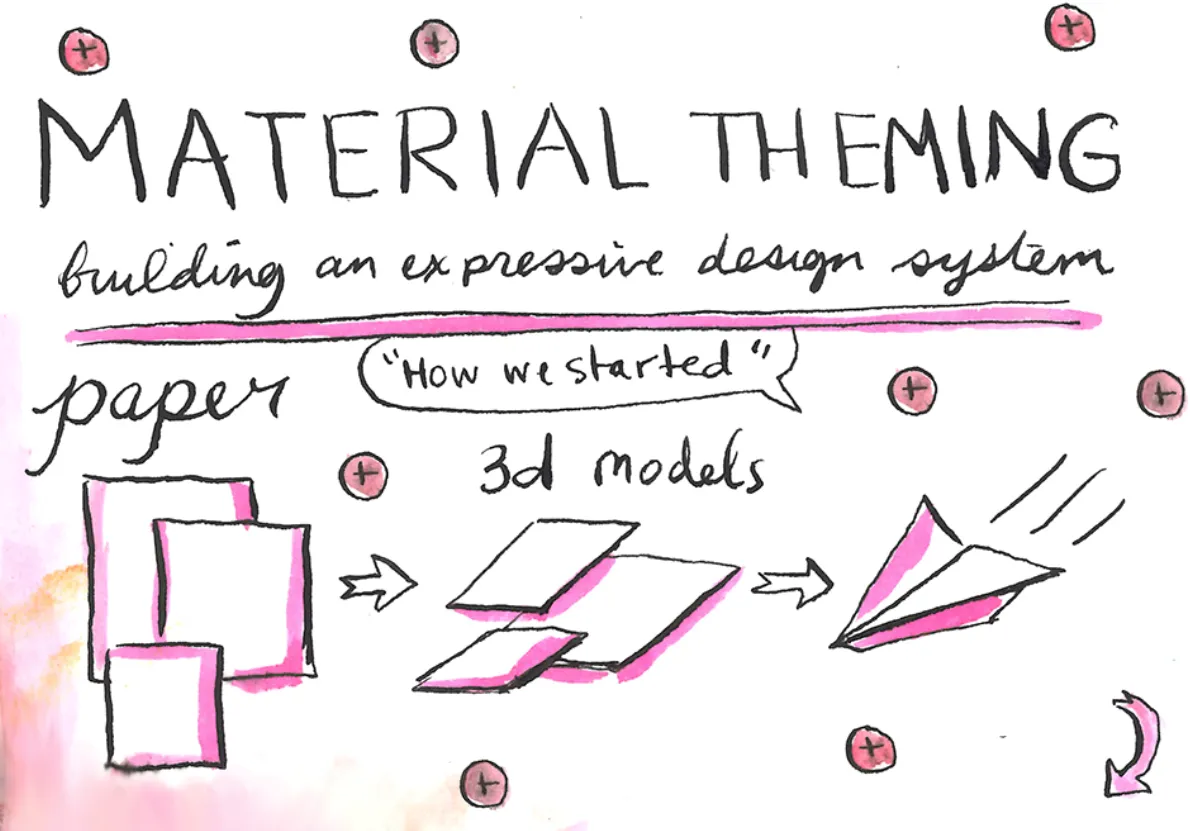
Michelle Alvarez and Yasmine Evjen discussed Google’s ongoing efforts to extend Material Design’s philosophy. They’re working on theming tools to allow designers more flexibility in brand expression within one of the most widely adopted design systems. You can see some of the fruits of their labor on Material Design’s website.
Julie Ann Horvath talked about deftly navigating the process of creating institutional partnerships within organizations to internally evangelize design systems and maximize their efficacy.
When considering a design system as a solution and stating its value to stakeholders designers should begin by gathering data to quantify the value proposition of investing in a systems undertaking.
“Us vs. them” thinking must disappear; good design systems incorporate the needs of diverse producers and consumers both within and outside of an organization. Strategic partnerships are necessary for success and that requires compromise and negotiation.
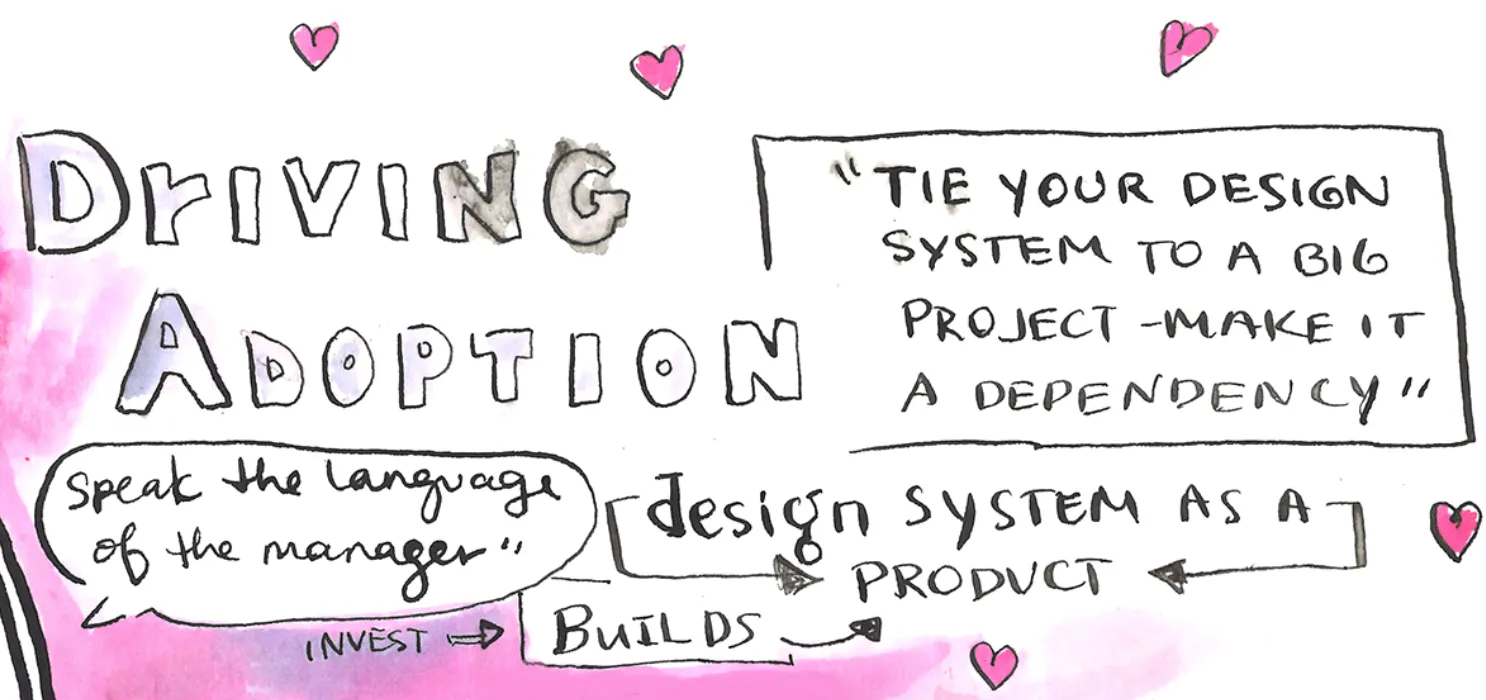
Orgs should invest heavily in the build process and treat delivery as a service or product to be designed. Components don’t create value until live in a production environment.
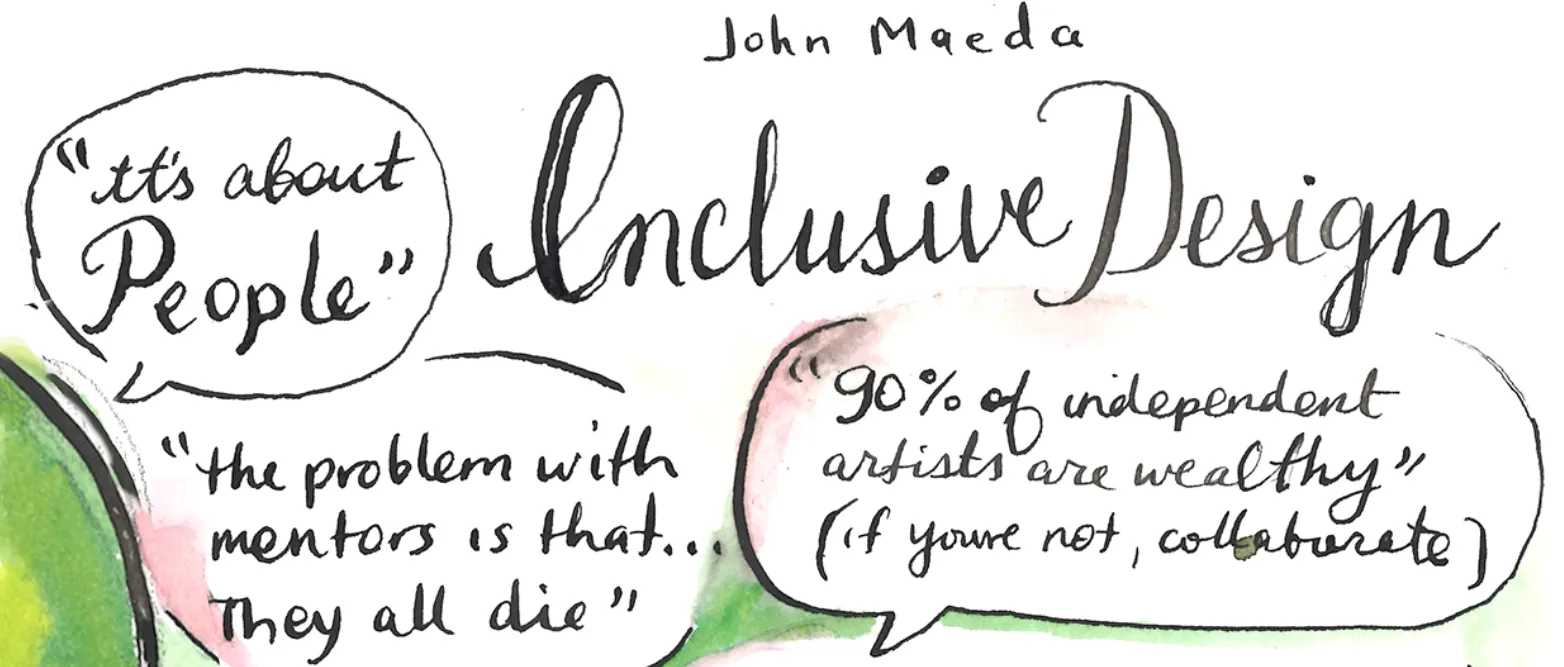
John Maeda followed up on Horvath’s momentum with a personal, humorous, and inspiringly philosophical take on where we are with design systems as 2018 comes to a close.
We’ve reached the stage of negotiating fluency in thinking about and creating design systems (it happened with stylesheets, responsive design, and many other technology paradigms before).
Design systems are a wonderful tool for enforcing organizational collaboration and finally killing auteur theory in design. I’ll let you wait for the recap to hear the rest!
Once you die, everyone forgets you almost right away… Your SEO just goes down the toilet.
Conclusion
Clarity was a blast! On top of all the great talks mentioned in this summary, there were workshops, happy hours with lightning talks, tech demos, and an after-party with a sweet view on the top floor of the New Museum (check out the photo album). A very special thanks to Jina and all of the other organizers, speakers, sponsors, and volunteers for pouring a bunch of love into organizing an event where so many amazing voices could be heard. Thanks to Figma and Katie Gregorio as well for selecting me for the conference scholarship!
More content from Clarity
Recap—Clarity 2018 on Youtube
Sessions (videos, sketch notes, transcripts, etc.) from Clarity
]]>Stedman HallidayNotes on Organizational Design2018-11-30T00:00:00-08:002018-11-30T00:00:00-08:00https://stedmanhalliday.com/blog/2018/11/30/notes-on-organizational-designThis article summarizes two talks on organizational design and design operations (aka “design ops”) by Peter Merholz and Kristin Skinner, authors of Org Design for Design Orgs.
Context
I’m a community manager at Designers Guild where we just completed a pilot run of Facebook’s new Mentorship feature (currently being tested in Groups and Pages). As part of our trial—along with setting up some organizational resources and gathering feedback—I participated in our 8-week, 6-step program as a mentee with a small cohort of other members who applied for the program.
Brad Monahan also moderates Designers Guild and agreed to help out by participating in the program as my mentor. Serendipitously, Brad is also a design manager at Uber and providing direction for designers’ career growth is a core function of his role there. Something that Brad and I began discussing early on is the kind of environment I’d like to work in for the next phase of my design career.
One thing that piqued my interest was the particular way in which Brad described his own job. He doesn’t see moving into management so much as ceasing to design but instead described it as designing different things (teams) to achieve impact in different ways. He unraveled this thread a bit for me and introduced me to a book called Org Design for Design Orgs and the emerging field of design operations (aka design ops). I ended up watching a couple of talks by the authors and annotating them for homework that week.
Org Design Notes from Peter Merholz
Org Design’s General Philosophy
Merholz contends that service design is the best lens to peer through in order to understand the core philosophy underlying org design.
All design is service design.
Many customer touch points occur throughout a journey.
Design can inform and drive a diverse set of business processes such as management, marketing, engineering, manufacturing, sales, and support.
Organizational Models for Design Teams
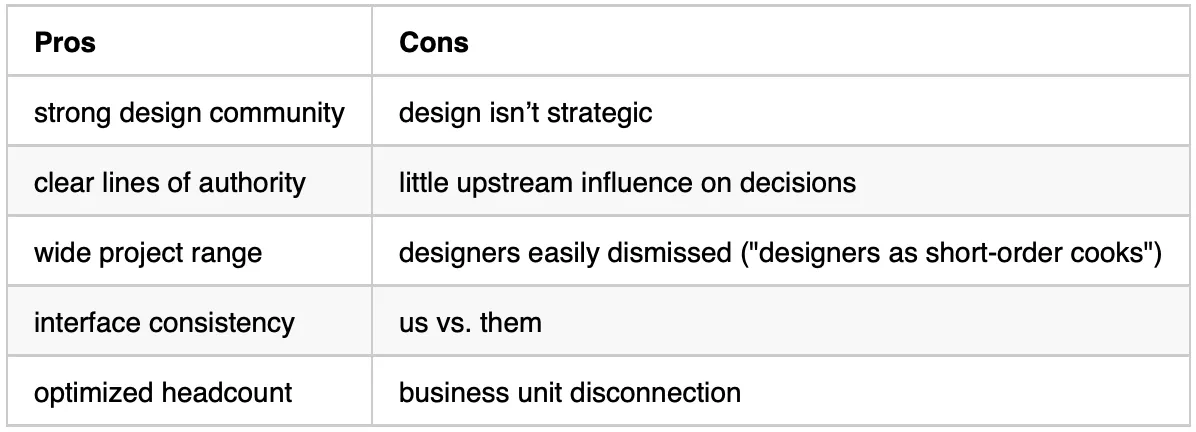
Organizational models for design teams can vary quite a bit. Merholz splits these into 3 major categories.
Centralized Internal Services
An in-house agency
This model is project-based.
Teams are organized by function.
Designers are farmed out on projects as needed.
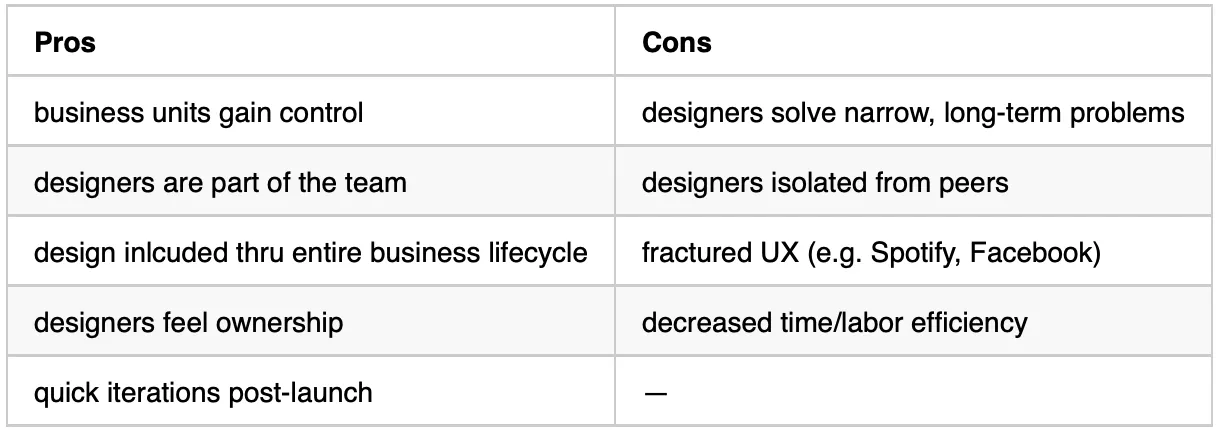
Common pros and cons of the centralized internal services model
Decentralized & Embedded
Everyone gets a designer; pods in squads
This model is program-based.
Designers are embedded as core team members.
It’s common for this model to create teams with 1, 2, or few designer(s).
Common pros and cons of the decentralized and embedded model
Centralized Partnership
The best of both worlds
Senior designers maintain connections to specialized org teams, while not necessarily embedded (i.e. decentralized and embedded model).
This makes sense since designers will possess deeper vertical skillsets later in their careers.
Less experienced designers become more modular gears, slotting into project functions as needed (i.e. centralized model).
It’s clear that Merholz favors compromise when it comes to the structure of design organizations. He identifies numerous advantages to hybridity:
Designers feel supported in their careers, skill development, and daily workplace needs.
Design teams maintain commitment to products and features.
Centralization helps maintain a holistic view across the entire customer journey and different segments of the organization.
Junior designers have mobility after shorter commitments.
Teams are organized by steps in the customer journey which prevents frequent team reorganization.
Org Design Notes from Kristin Skinner
Delivering Great Experiences
To deliver great experiences… I just need to get the _______ right.
Design? 🚫 Nope!
Strategy? 🚫 Guess again.
Organization… ✅ Bingo!
To deliver great experiences… I just need to get the organization right.
Business First
Designers need to show up like business people first, just like any other discipline.
—Bob Schwartz, GM Global Design, GE Healthcare
Lesson #1:
You can’t change the product or service without changing the organization.
The 12 Qualities of Effective Design Orgs
Skinner identifies three categories of useful qualities in design orgs.
Foundation
1. Shared sense of purpose
2. Focused, empowered leadership
3. Authentic user empathy
4. Understand, articulate, and create value
Output
5. Support the entire journey
6. Delivers at all levels of scale
7. Establish and uphold standards of quality
8. Value delivery over perfection
Management
9. Treat team members as people, not resources
10. Diversity of perspective and background
11. Foster a collaborative environment
12. Manage operations effectively
Decision Making
Half the decisions in organizations fail.
—Paul Nutt, Author and Professor, Ohio State University
Fragmented decision making can have an outsized impact.
Here are some study results on the number of viable solutions to business problems generated from different decision-making processes (ranked):
Identifying performance gaps
Goal setting
Problem solving
Leader makes decisions
More inclusive and participatory management styles yield more solutions.
Lesson #2:
Much of what causes designers to stress about their work is the result of flawed operations.
The 5 Stages of Design Org Evolution
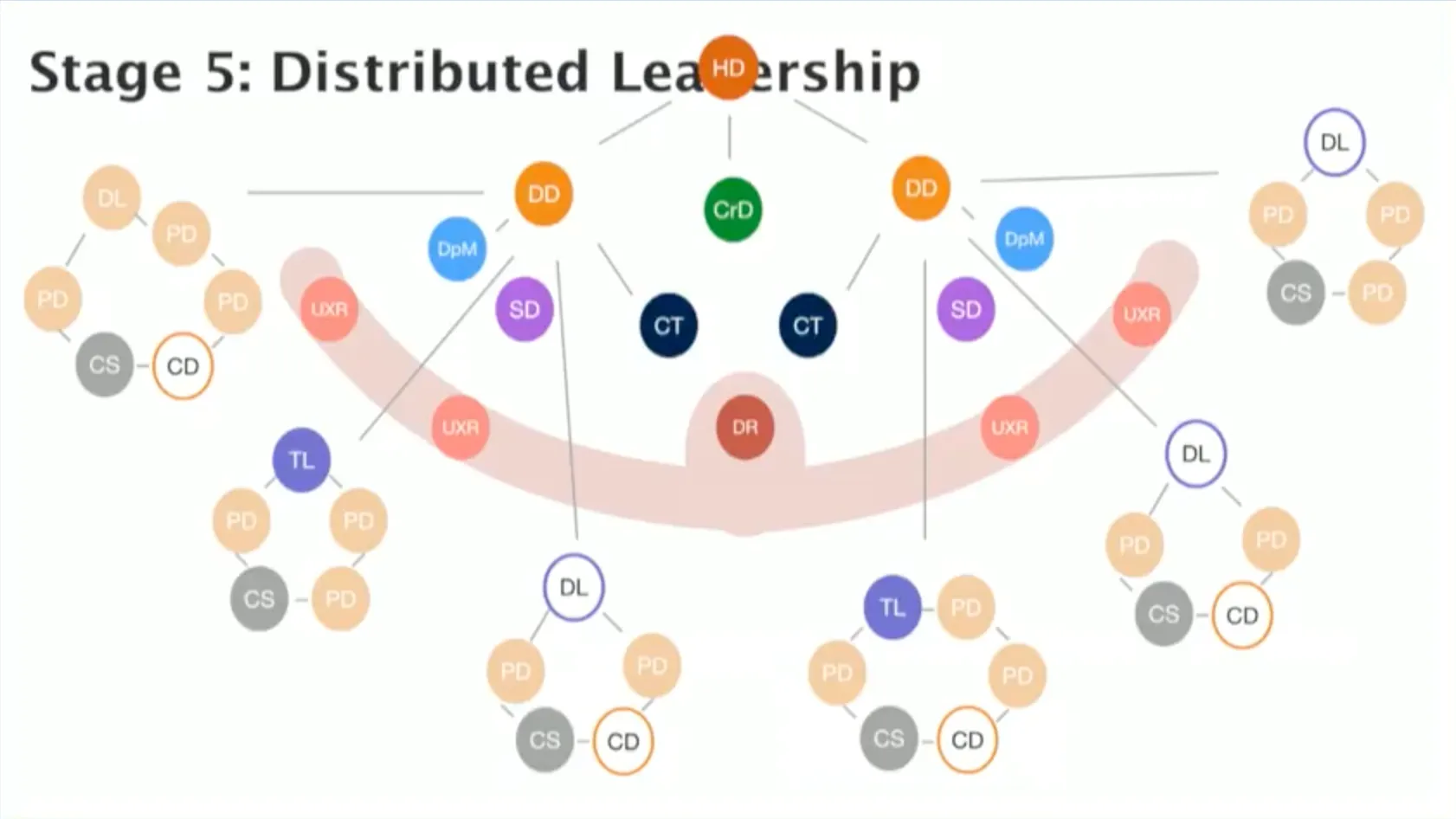
A diagram of a Stage 5 design org from Skinner’s Keynote
Stage 1: The Initial Pair
The smallest design organization possible is a team of 2.
Head of Design
Traits: creative, managerial, operational
A maker at this stage
Product Designer
Focuses on structure and surface of design solutions
Examples: interaction design, visual design, etc.
Stage 2: Full Team
This stage may add more product designers.
The team now consists of 5–7 people.
Specialized hires are brought on (not limited to the examples below):
Content Strategist
Responsible for voice and tone, content structure, and copywriting
Communication Designer
Owns visual design through multiple channels: online and offline, brand applications, information design, etc.
Stage 3: Design Org
The org now comprises at least 20 people. More examples of additions follow:
Team Lead
A people manager type with domain expertise who’s still practicing
UX Researcher
This is a generative and evaluative role that is ideally highly leveraged throughout the org.
Head of Design (revisited)
At this stage it’s common for HoD’s to struggle with scale and cede the role to directors with more experience.
Stage 4: Coordinated Org
This stage is primarily focused on managing scale-related complexity.
Service Designer
These designers integrate strategy and structure across teams.
Design Lead
This people manager (possibly team lead), is still practicing.
Design Practice/Program Manager
This manager focuses on practice, communication, and prioritization, working towards an overall objective of organizational effectiveness.
Stage 5: Distributed Leadership
This is the final growth taxonomy of design organizations in Skinner’s model.
Design Director
This leader oversees a swath of experiences across teams.
Creative Director
This leader establishes quality standards via creative leadership.
Research Director
This director leads a team pursuing research to create an insights hub.
Creative Technologist
This designer-developer (not a front-end dev) prototypes new experiences.
When to Introduce Design Ops
It’s time to introduce design ops when your org suffers from:
difficulty with cross-functional collaboration within the entire org
unsuitable project or program staffing
poor visibility into related work streams
duplicated efforts across teams
non-existent measurement infrastructure
fragmented decision-making
Operational Spectrum
“Little o” Operations
Removes sand in the gears by meeting designers’ daily workplace needs like:
scheduling and budgets
tools and procedures
communication and coordination
measured by efficacy
“Big O” Operations
The work about the work including:
annual planning for adequate headcount
market-appropriate compensation packages
performance review adjustments to suit designers
facilities and IT to support collaboration
policy changes to support real customer research
A high-performing design management practice coordinates efforts and knowledge sharing, facilitates prioritization, guides quality and effectiveness, and enables and environment where designers want to grow.
Design Management
These are examples of roles that work toward the above stated goals:
Design Practice Manager
partners with design leads to manage design-related business matters
connects HoD to stakeholders and other HODs
prioritizes efforts for impact
allocates personnel suitably
ensures effective delivery
Design Program Manager
partners with design leads on all of the highest-priority initiatives, programs, platforms
flexes between strategy and tactics within the design process
ensures program and team health
delivers exceptional human-centered products
Design Operations
This team is core group of operations, finance, and relationship experts providing shared services across a design org.
Emphasizes health of practice, people, and projects
Introduce measurement and reporting for better decision-making
Roles Summary
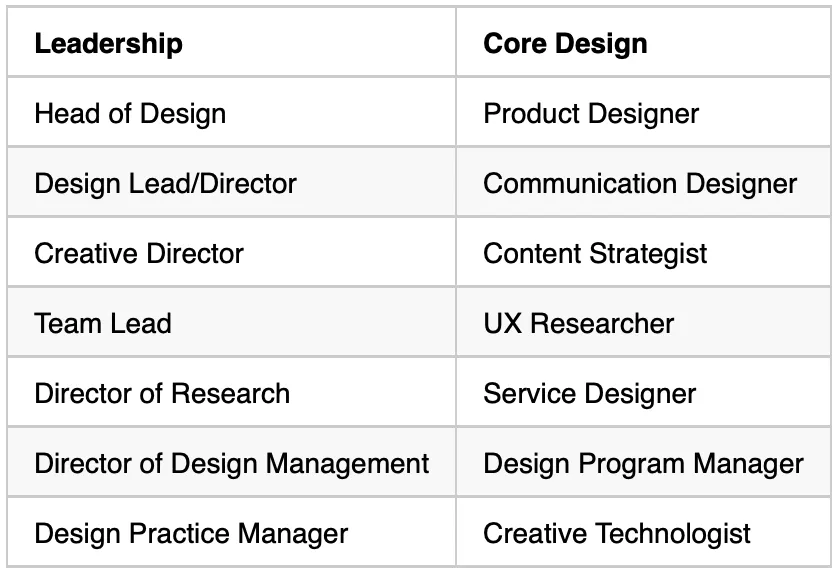
Summary of core design and leadership roles discussed in the keynote; unlisted positions are possible
Final Lessons
Lesson #3:
There is no one-size-fits-all for design ops.
Lesson #4:
It takes a relatively small team to have outsize impact.
Lesson #5:
When learning something new, share generously. Don’t fear judgment; judge conservatively.
Designers Guild is a Facebook community comprising designers from 100 countries committed to discussing, learning, and growing together. We just celebrated our 15,000 member milestone by releasing a handful of awesome prizes sponsored by some great design-driven companies. Thanks so much to Sketch, Dropbox, UXPin, Skillshare, Adobe Creative Cloud, Semplice, and Animoodles for their generous contributions to our members. Special thanks to Tanner Christensen and Marissa Louie for organizing the giveaway!
]]>Stedman HallidayMailchimp Rebrand: First Impressions2018-09-27T00:00:00-07:002018-09-27T00:00:00-07:00https://stedmanhalliday.com/blog/2018/09/27/mailchimp-rebrand-first-impressions
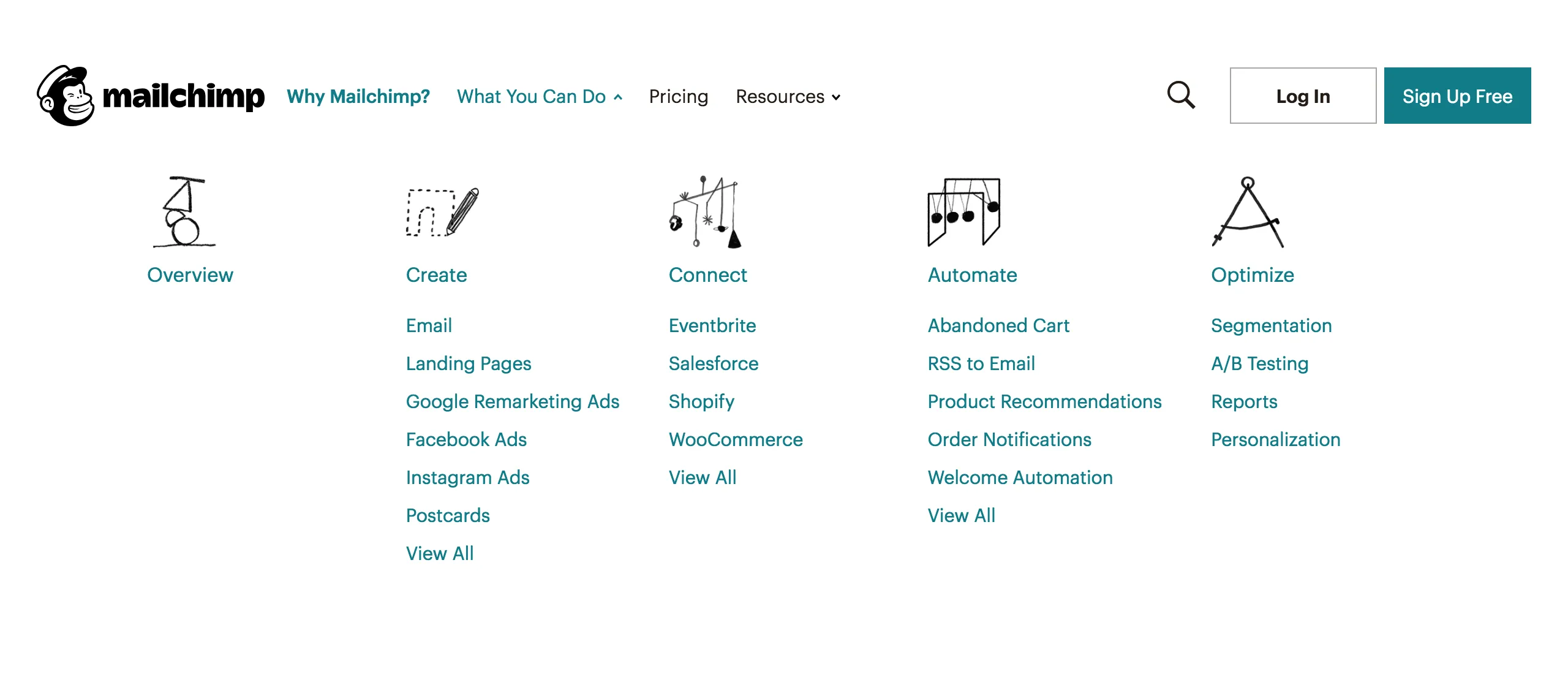
In case you haven’t heard, MailChimp is now Mailchimp. That’s right, it’s #rebrand season! Get an overview of what’s new on Fast Company and dive in a little deeper at Mailchimp Design.
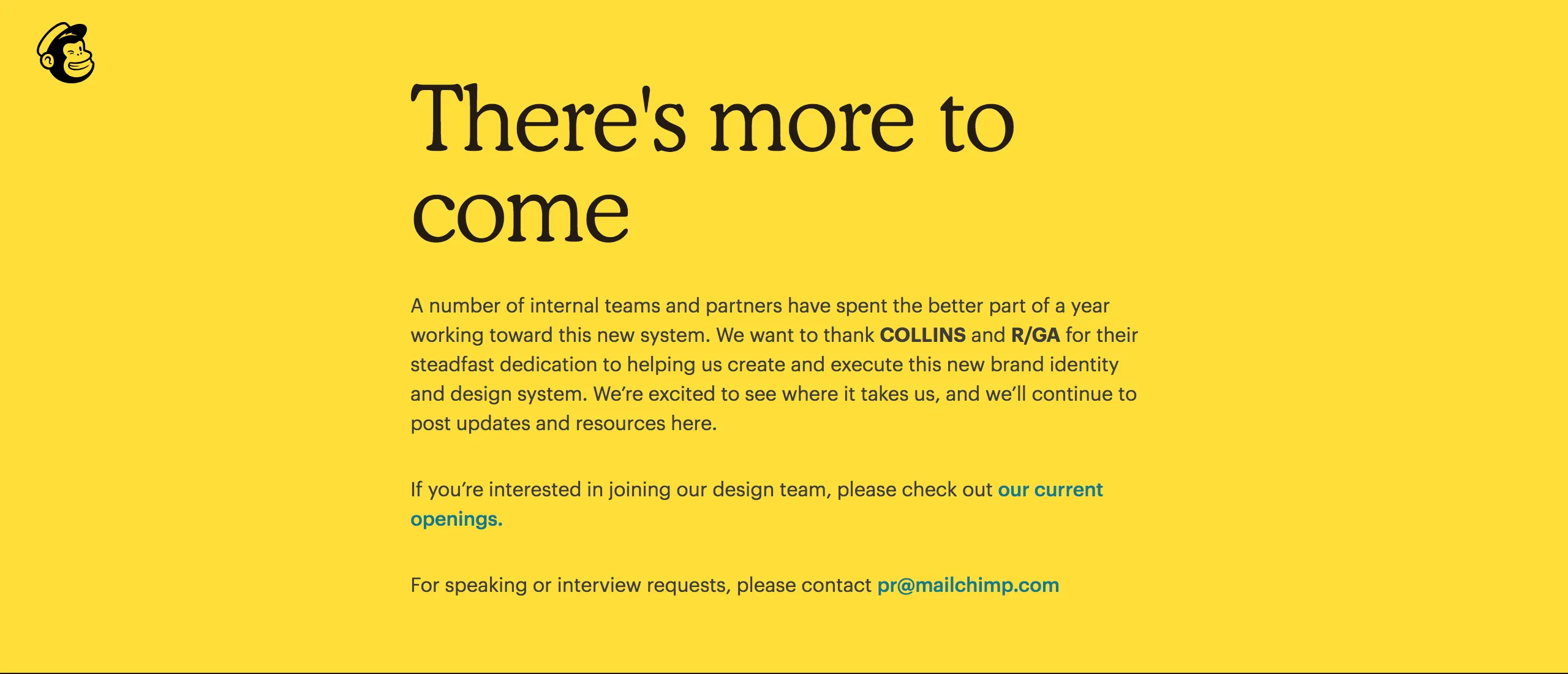
This article was inspired by a thread in Designers Guild, a Facebook community that I help moderate. Designers Guild consists of 10,000+ designers committed to discussing, learning, and growing together. Jon Bell (Senior Design Manager at Mailchimp) unveiled the company’s fresh rebrand (with support from Collins and R/GA) and asked the community for its thoughts. After digging into the work a little and sleeping on it yesterday, I had the opportunity to prepare some more fleshed out opinions this morning (prompted by Jenny Earnest).
Freddie Forever!
It’s nice when a rebrand can preserve the iconic elements of a company’s history, so I like that Mailchimp kept Freddie as a logo. The lockups with the new wordmark also look fantastic; they preserve the lighthearted quality of the old script logotype, but find harmony with Freddie’s weightier aesthetic. The team nailed the logo portion of this rebrand.
Mailchimp’s new logo lockup (now with 🔥 inktraps)
I enjoy how the other design elements (such as typography and illustration) coalesce and the Cavendish swatch dignifies everything pretty nicely. The aesthetic gestures are very appreciable on the surface, but after some more consideration, I’m not 100% convinced that the design supports the right message for Mailchimp. Perhaps this is more a critique of the marketing considerations of this rebrand (as opposed to the design ones).
Identity: A Balancing Act
A brand’s identity isn’t solely determined by its stakeholders; it’s negotiated with an audience over the brand’s lifetime. One of the most difficult aspects of rebranding is balancing the internal desire to redefine a company’s communication strategy with the need resonate with customers, representing their shared history and experiences with the brand. Mailchimp’s choice of a primary marketing message may make that somewhat difficult.
The Overarching Message
From Mailchimp Design:
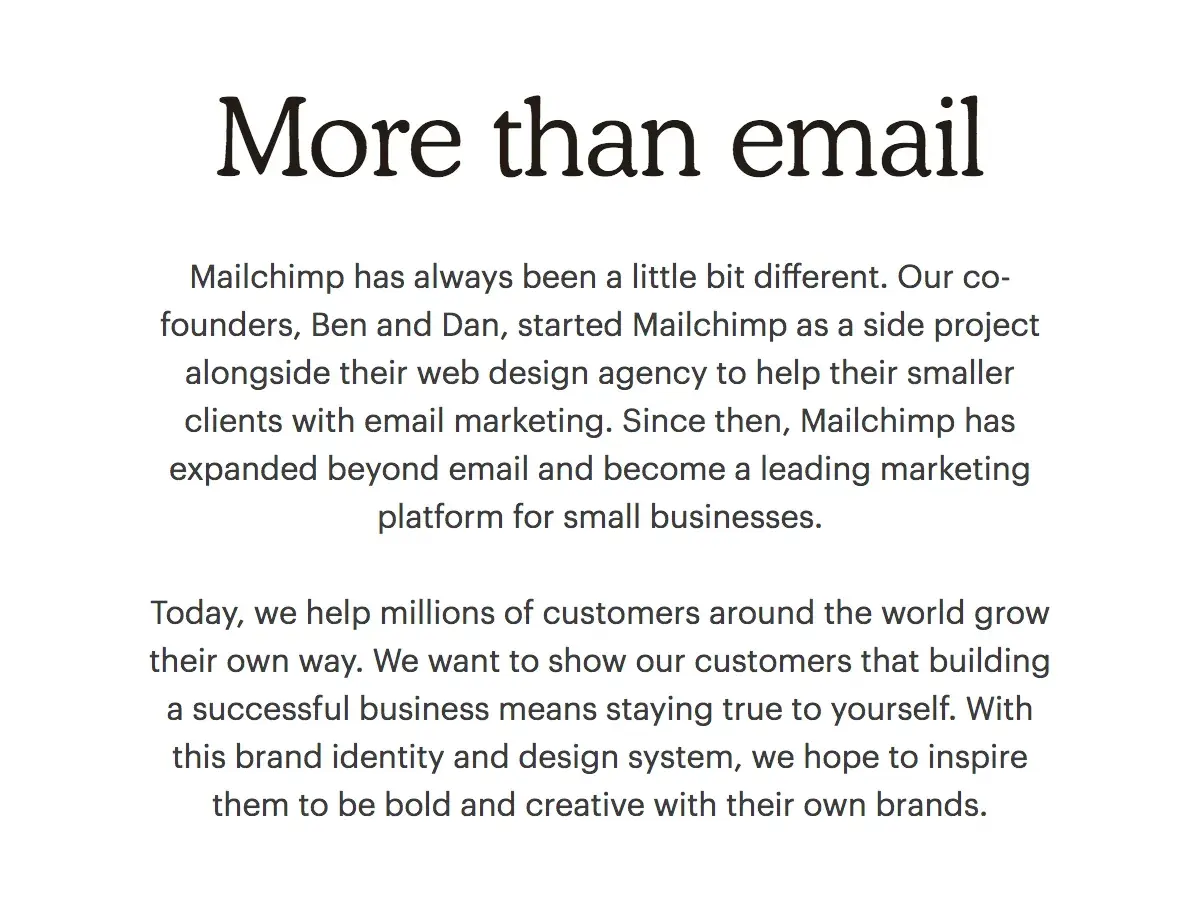
Mailchimp has always been a little bit different… We want to show our customers that building a successful business means staying true to yourself. With this brand identity and design system, we hope to inspire them to be bold and creative with their own brands.
The Design Decisions
The overarching message of staying true to yourself and being bold and creative are primarily supported by the following new design elements:
the rough, expressive, and naïve illustration style
Cooper Light: a quirky typeface with a correspondingly odd vernacular history (“You may have seen its larger cousin on dusty old funk records and inside questionable sandwich shops.”)
Bold and creative to be sure… but is Mailchimp staying true to itself?
The Disconnect
The biggest potential issue with Mailchimp’s rebrand is that it doesn’t strongly connect its new marketing message to the value proposed by its existing portfolio of products and services. The pitch for customers to be bold and creative presents a vision that is perhaps too wide and ambitious to resonate powerfully with real customer goals in the present. It seems as if Mailchimp is paying more attention to who or what it wants to be to its customers than to what customers expect and desire from its offerings.
Take a look at Mailchimp’s current products. To be fair, the email and landing page templates are key offerings that are indeed geared towards creative empowerment, but how easily does something like segmentation inspire boldness and creativity? In contrast, how many of these products and services are concerned with helping businesses reach people in better ways? (Hint: literally, all of them are about that.)
Here’s what Mailchimp actually offers customers.
At present, the primary marketing message (and as a result, the look and feel of the rebrand) seem somewhat out-of-touch with what Mailchimp actually does (or rather, what it has done historically). With email marketing having been the company’s bread and butter and the central touchpoint for its customers since its inception, it’s not hard to imagine some other directions the rebrand could have gone in.
The concept of mail and traditional postage’s historical role in cementing human connections are ripe with readymade marketing metaphors for how a business can improve communications with its customers. Plenty of the playful design language that the agencies ultimately landed on can be housed under marketing messages more concerned with what the company actually offers: business solutions for reaching people.
When it comes to examples of brands that have navigated this divide adeptly, I think back to the popular G Suite advertisement which imagines Hall & Oates collaborating on the lyrics to Maneater in Google Docs. The message resonated well with customers because it included the spirit of originality and playfulness that Mailchimp is clearly after with this rebrand. However, it did so without deviating from the central value prop of the product: collaborative word processing.
Hall & Oates “Maneater” ad for GSuite
More Than Email
At this point, it’s pretty clear that Mailchimp is seeking to define itself beyond the confines of the email marketing niche (they even said so). It also seems somewhat ironic that they chose to focus on inspiring and enabling creativity when that focus is disconnected from the parts of the business which practically extend beyond email: connection, automation, and optimization.
David Martinez also made a solid point about the rebrand appearing to understate the company’s success in the email marketing niche. Mailchimp’s new approach doesn’t seem very reflective of the actual impact and scale of one of (if not) the largest email marketing platforms on the web experiencing daily growth on the order of 14K+ customers. The rebrand may be just as incongruent with what users want and expect out of the company’s products.
Is it fair to ask why Mailchimp feels the need to aggressively outgrow its roots? Is the company failing to embrace its own stated brand value of staying true to itself? It’s great that Mailchimp wants to inspire originality in brands that adopt it for marketing, but what if that’s not the value prop that customers are connecting with?
Looking Forward
Pressing questions aside, I’m inclined to give Mailchimp the benefit of the doubt overall. Aiming to inspire originality and creativity instead of simply helping businesses reach people with better marketing services is an ambitious endeavor to say the least, and I respect that. It’s a bold decision to eschew the more banal SaaS marketing and branding tropes in favor of a mission that means something important to Mailchimp’s team and their story. The caveat is that I’m not sure whether or not a new brand identity and design system alone are enough to inspire users in that fashion.
If Mailchimp truly desires to be more than mail and empower creativity, its product offerings may need to evolve in tandem with its new brand philosophy.
Design templates are a start, but will Mailchimp introduce any new offerings to truly assist brands in finding and crafting their bold, courageous, creative, and authentic voices? Only time will tell, but I’m excited to see what unfolds since the company has teased more to come. It’s clear that Mailchimp has embraced the decisions underlying its new brand identity as a living set of principles intended to evolve with the business instead of edicts set in stone and that’s a very good thing.
Congrats to all teams involved with the new rollout!
Appreciate this post? Have any thoughts about modern rebrands and SaaS marketing? Want me to critique your brand materials?
Message me on X (Twitter) and let me know.
]]>Stedman Halliday for [Prototypr](https://blog.prototypr.io/)What I’ve Learned from Mentorship2018-08-27T00:00:00-07:002018-08-27T00:00:00-07:00https://stedmanhalliday.com/blog/what-i-ve-learned-from-mentorshipCorita Kent, also known as Sister Mary Corita, was an artist with an innovative approach to design and education. (Source: Corita.org)
Cool news: I’ve been working with the leadership team at Designers Guild to launch an online mentorship program this September. Designers Guild is a community of 10,000+ designers committed to discussing, learning, and growing together. The outpouring of interest in our upcoming program (over 400 pupils and 100 mentors have applied) encouraged us to open up a dialogue about mentorship expectations and experiences. Here are some of my stories.
My first mentor
My first mentorship experience began after I started contracting freelance design work in high school. (This was the start of my design career around eight or nine years ago.) After a couple years of independently learning how to design and code, a friend’s dad commissioned me to produce a website for his legal firm. I was around 15 years old and it was my first freelance gig. It went well and I quickly landed another project via referral, this one with a senior designer on it.
This designer—who became my first mentor—was in his 50s with a lot of more traditional agency experience. Our communication styles meshed well and we got along instantly. My skillset complemented his experience well. He would handle the clients, lead design direction, manage projects, and present work. I filled in the gaps with my knowledge of technology and new media. We’ve worked together on a lot of projects since.
Pros:
I learned about the administrative and hustling aspects of freelance work; my communication skills with clients and collaborators flourished.
I gained a ton of confidence and experience through immersion.
I began a long relationship with someone who remains an important part of my professional support network.
Cons:
There was a generational gap between our hard skillsets.
I didn’t frequently get opportunities to push the limits of my skills or creative sensibilities.
Some of the work and clients became less appealing over the years as my interests matured; I sought more opportunities for growth.
My second mentor
It was the summer after my first year of design school and I’d been working alongside my first mentor for a couple years. It surprised me to learn that his wife was a renowned food photographer. He got me a second job managing her studio while I worked a design internship. Despite not being a designer, she became my second mentor. I learned far more from her than at my internship that summer.
My old mentor left agency life behind for a more flexible freelance routine, but his wife was the hardest hustler I had ever met. Alongside shooting, she ran a brick-and-mortar studio that doubled as an event space. She had a lot more administrative overhead to manage. She set the bar high for me and pushed me very hard, but never failed to praise and reward me when I met her expectations.
Pros:
I learned a ton about entrepreneurship and the day-to-day details of running a business (versus freelancing).
Managing and facilitating larger on-site productions became second nature. Necessity forced me to learn many things quickly.
I began to understand that I liked providing value more than making things. I felt most rewarded when my skills worked in tandem to maximize the value I could provide.
Cons:
My hard skills and career trajectory were even more misaligned than they were with my previous mentor.
Working two jobs led to my first experience with burnout the following semester.
I possessed neither the foresight nor soft skills to make lasting connections in a parallel creative industry.
My last mentor
My last mentor was assigned to me in design school. In hindsight, I didn’t have the social/emotional maturity to take full advantage of that relationship. The fact that school was a more pressurized environment exacerbated this. I loved my mentor’s energy as a person, but her communication style wasn’t compatible with mine. I felt that she was rather abstract and indirect at times. Even though I studied graphic design in a program of my choice, the perfect mentor was elusive. Finding someone with a matching philosophy, skillset, and communication style was difficult. Prompted by our skillset incongruence, my mentor instructed me to seek other advisors. This became an obstacle to transparency, resulting in negative feedback on important work.
Pros:
She bolstered my focus on ethics. She once said she’d eat canned soup every night if it meant she got to do the work that made her proud.
She never stopped encouraging me to write.
I grew after-the-fact by learning from my failures.
Cons:
Our communication styles were incompatible.
Our philosophies, skills, and career trajectories were somewhat mismatched.
The pressurized environment and academic consequences led to a decline in my confidence.
Key takeaways from my mentorship experiences
One of the most crucial aspects of a mentor-pupil relationship is communicative compatibility. Ideas don’t mean anything (or may even become harmful) when lost in translation.
Experience is the best teacher. Sometimes, it’s quite important that a mentor has walked the (approximate) path that a pupil would like to take in their career.
Despite a mismatch in hard skills or career trajectory, a pupil can still learn a lot from a mentor. Sometimes what complements a pupil’s hard skills and fills in the gaps can be just as—if not more—important to their long-term success.
A good mentor will challenge pupils, hold them accountable, and examine failures to create teachable moments, but will also remember to reward and praise pupils, emphasizing their strengths.
Good mentors usually ask a lot of questions before giving advice. Inquiry before judgment is a strong general principle for teachers.
Pupils are responsible for pulling the best out of their mentors—not just the other way around. Pupils must be proactive and learn to actively solicit mentor input to meet their unique needs.
My most recent relationship with a mentor was my most difficult, but I may have grown the most from it. I learned how to be more proactive and ask for what I need. I realized how important a good cultural and environmental fit is to the success of individuals and institutions. I learned about my limitations and what I could do to address them.
Overall, my experiences have left me with a desire for a mentor whose philosophy, experience, and goals more closely match my interests. I’m at a point in my career where I know a bit more about what I want than I did in design school. Failing that, at least I know which questions I’ve got to ask to find the right answers. Finding a strong fit and learning from community feedback are what I’m most excited about when it comes to starting a new mentorship program.
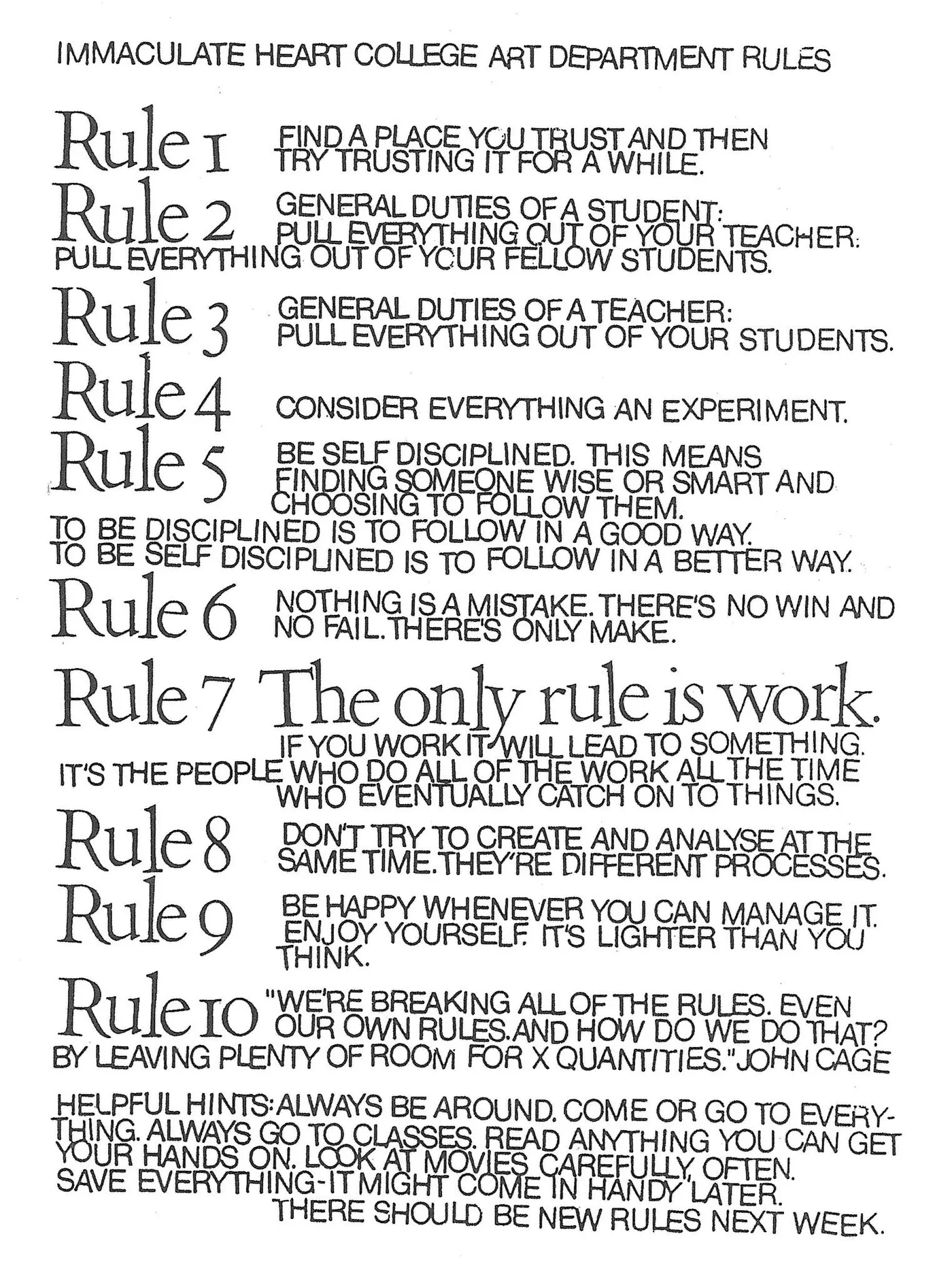
I’d like to conclude this story with some wisdom from Sister Corita Kent: a notable educator in the arts. Below are her famous rules for the Immaculate Heart College Art Department. Many of them apply to relationships between mentors and pupils.
RULE 1: Find a place you trust, and then try trusting it for awhile.
RULE 2: General duties of a student — pull everything out of your teacher; pull everything out of your fellow students.
RULE 3: General duties of a teacher — pull everything out of your students.
RULE 4: Consider everything an experiment.
RULE 5: Be self-disciplined — this means finding someone wise or smart and choosing to follow them. To be disciplined is to follow in a good way. To be self-disciplined is to follow in a better way.
RULE 6: Nothing is a mistake. There’s no win and no fail, there’s only make.
RULE 7: The only rule is work. If you work it will lead to something. It’s the people who do all of the work all of the time who eventually catch on to things.
RULE 8: Don’t try to create and analyze at the same time. They’re different processes.
RULE 9: Be happy whenever you can manage it. Enjoy yourself. It’s lighter than you think.
RULE 10: “We’re breaking all the rules. Even our own rules. And how do we do that? By leaving plenty of room for X quantities.” (John Cage)
HELPFUL HINTS: Always be around. Come or go to everything. Always go to classes. Read anything you can get your hands on. Look at movies carefully, often. Save everything — it might come in handy later.
There should be new rules next week.
Did you like this post? Do you have any thoughts about or experiences with mentorship that you’d like to share?
Message me on X (Twitter) and let me know.
]]>Stedman HallidayQ&A: How can digital designers mix RGB colors more effectively?2018-02-05T00:00:00-08:002018-02-05T00:00:00-08:00https://stedmanhalliday.com/blog/rgb-color-mixing.md
Q&A is a column in which I’ll post long-form answers to thought-provoking questions. This particular question was inspired by a thread in [Designers Guild](https://facebook.com/groups/designguild), a Facebook community that I moderate. Designers Guild consists of 10,000+ designers committed to discussing, learning, and growing together.
The question
Recently, pixel artist and game designer Slynyrd published a great blog post walking readers through a process for creating awesome pixel art color palettes. The tutorial focuses on selecting colors by manipulating HSB properties (hue, saturation, and brightness). This prompted a question about designers’ favorite ways to mix color.
The answer
I’ve always found generating HSB swatches to be the most intuitive method for novice designers to make color selections. Generating a single swatch with the HSB scales feels the most analogous to picking out a swatch from a color book in real life: you basically choose the general color you want (hue) then filter down to find your swatch by selecting for finer attributes of that general color (saturation and brightness). These three properties of a color are what give the scale its name (HSB = hue, saturation, brightness).
However, over the last couple years, I’ve taken a liking to directly mixing RGB in many situations (especially when it comes to building out larger palettes). Instead of picking swatches from a color book, it’s more analogous to mixing paint in a palette (except that mixing in RGB is additive rather than subtractive, so it’s technically mixing light; more on this later). RGB is named for the three channels of light mixed to produce an onscreen color (RGB = red, green, blue).
Like a swatch book, HSB provides a great scale for finding a color. It can be useful for pinning down a match for the color you’ve seen in your head, on a screen, or in the real world. Like a painter’s palette, RGB provides a great space for mixing color. It can be used to create organic and harmonious relationships between two or more colors in a palette.
While HSB can be like a swatch book for finding colors, RGB can be like a palette for mixing them.
The main idea
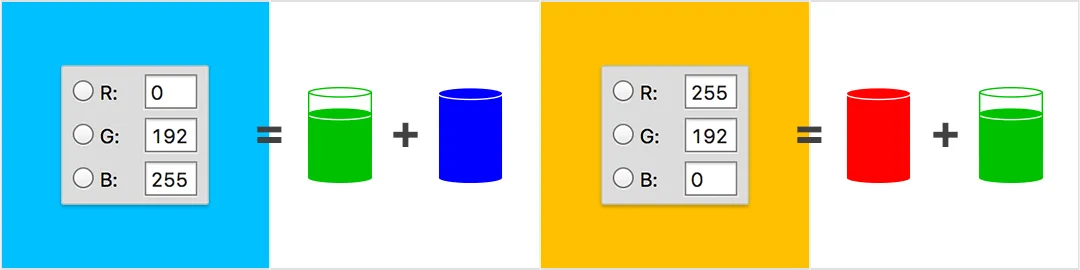
To start mixing in RGB, think of each channel as a bucket of red, green, or blue paint. With 8 bits per channel, you have 256 levels of granularity for how much of that color you want to mix in; 255 is the whole bucket, 192 = three quarters, 128 = half bucket, 64 = quarter bucket, and so on. Once in the ballpark, you can adjust the mix by finer increments (e.g. 4 = 1/64 bucket).
Removing color from the red channel results in darker, less saturated reds. At 64, the channels is 1/4 full.
What I like about this method: preserving the channel ratios across colors and finding ways to recombine and riff on them can create more natural color harmonies amongst all of the swatches that end up in my palette. There’s something poetic about building color palettes by using the parameters of the color space itself as mixing model. When I finally got comfortable with this method, it felt a little like when I first understood how to utilize the grid for layouts; you’re not just picking a set of colors that look good, you’re outlining a system that encourages discretionary relationships in order to arrive at it.
Channel ratios: the cerulean and yellow swatches above both have equal amounts of green (3/4 channel) mixed into another full channel (either blue or red).
By simply swapping a full blue channel for a red one, we’ve arrived at a yellow that complements the cerulean quite nicely.
Comparison with HSB
Comparatively, the same result can be attained in HSB by shifting the hue +210º (7/12) or -150º (-5/12). This exercise can often get a little more arbitrary for two main reasons:
Different hues are affected unequally by brightness and saturation shifts as a result of varying natural value and chroma (for example, at a given saturation and brightness we still perceive a yellow hue as brighter than a violet one). The perceptual distance between a pure hue and white for example can also vary depending on which hue you’re working with.
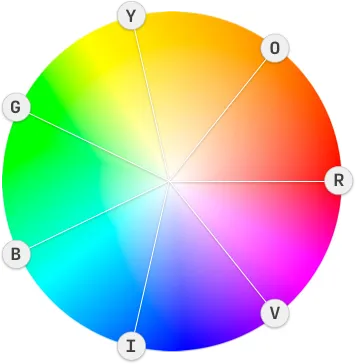
Spatially mapping the distance from red to magenta onto the 360º of a circle can make for a less-than-intuitive visualization of hues. If color stops were placed in regular intervals along this scale, some shifts in hue might appear greater than others even though the stops are equidistant. This is also a result of the varying natural value and chroma of each hue. The best way to visually estimate which degrees correspond to which hues in HSB is with the old mnemonic from science class for the colors of the visible light spectrum: Roy G. Biv (red, orange, yellow, green, blue, indigo, violet). Notice that this doesn’t map too cleanly onto the color wheel in even increments (blue and indigo are off the mark).
Visualizing hue in degrees is difficult. Using ~51.5º increments, blue and indigo are off the mark!
All that being said, mixing in HSB isn’t bad at all. Here’s a good primer on it. The rest of this answer will focus on the strengths of an RGB mixing process.
Additive vs. Subtractive Color
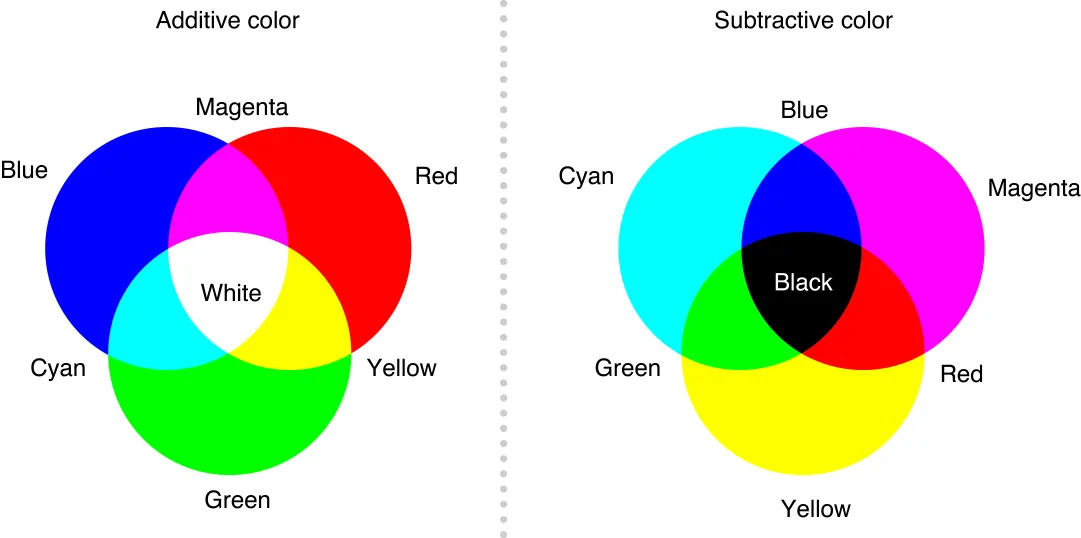
Something mentioned earlier was that RGB is additive rather than subtractive. What additive means is that adding more color information from any channel adds light to make brighter colors, ultimately resulting in white. You can see the summation of colors resulting in white in the color wheel graphic above as well as the diagram below. Compare this to subtractive mixing, where more color information subtracts light to make darker colors (ultimately black).
Additive color adds light to make white. Subtractive color subtracts light to make black.
Example: Cool Gradient
Here’s an example of how I like to mix colors in RGB. We’ll begin a palette by making swatches to create this cool gradient:
Starting with blue
1. We know we want to start with a blue, so let’s just flood the blue channel all the way; RGB(0,0,255).
Flooding the blue channel all the way gets us a deep blue.
2. Good start, but it’s too dark and just too blue.
We’d like a lighter color—remember that since RGB is additive, we can get that by adding color information to another channel.
We’re going to be matching it with a greener hue, so it makes sense that the channel we add should be green.
Looking back at the additive color diagram, mixing a full blue channel with a full green channel results in cyan. We want a lighter blue but not that light.
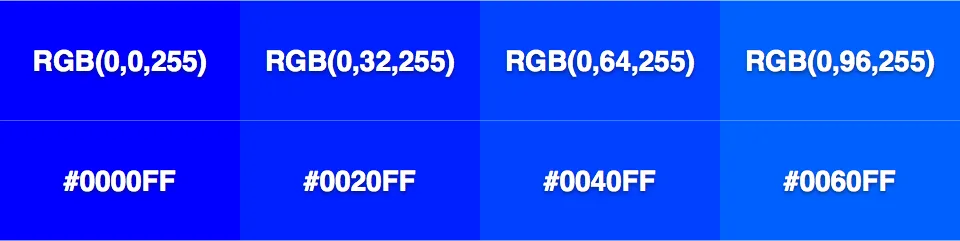
We can add green in small amounts like mixing paint in to find a sweet spot. What if we split our channel (256 levels) into eighths (256/8 = 32)? That way, every time we add 32 levels to the green channel, it’s like moving 1/8 of the way from full blue to cyan.
Adding 32 (1/8) green each time gradually creates a lighter blue (moving towards cyan).
That last iteration looks pretty good; blue, but not too dark and not too saturated. We also have a really clean ratio between channels: RGB(0,96,255) = 0:3:8 RGB ratio.
From blue to green
Now that we have a nice blue swatch, let’s get another concordant swatch going. Looking at our intended result, we want this one to be greener and a good bit brighter.
1. Let’s take care of greener first.
Remember that our first color was predominantly blue, but had a little green added to move it towards cyan.
Swapping the values for the G and B channels will get us a color that is equidistant from cyan, but predominantly green instead of blue.
Swapping the values of the blue and green channels gives us an analogous green swatch.
2. Lookin’ alright! These swatches already feel quite analogous in terms of brightness and saturation because they share similar channel ratios.
Both swatches are equidistant from white in the color space since the total amount color in both swatches is equivalent. Both have 351 levels (96 + 255), but they’re just distributed inversely across the blue and green channels.
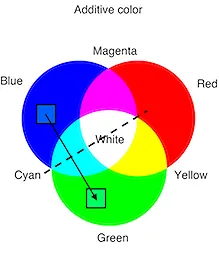
The analogous nature of the colors is enforced by our logical use of the additive color chart. Essentially, the result of inverting the channel values was to reflect our original color across the cyan axis of the chart.
Reflection across the cyan axis; both colors are equidistant from white.
3. We’re off to a good start, but looking back at our intended result, we want a cooler palette that might call for a bluer green with a lighter touch; something closer to cyan but not quite.
Our intended result lies in the direction of cyan; we want to add color to the blue channel.
We know that adding blue will get us there, but how much blue do we need? This is a good time to revisit the channel ratios.
RGB(0,255,96) = 0:8:3 RGB ratio… what if we just mixed in double the amount of blue? This would get us a 0:8:6 ratio — not all the way to cyan but enough to cool our green down.
The sweet spot: a nice, strong aquamarine with a 0:8:6 RGB ratio.
Looks like the sweet spot: a nice, strong aquamarine with a 0:8:6 RGB ratio. The ratio keeps our channels in 8 parts and plays really nicely with our other color’s 0:3:8 ratio.
We’ve now mixed both the swatches necessary for our original cool gradient.
From this point, we can shuffle the ratios even more to discover additional harmonious swatches inside the spectrum we’ve just established. We can make more minute adjustments using the same logic of splitting the channel levels into smaller fractions. We can bring in some of the starting blues from before for dark swatches, or even start incorporating the red channel into our existing ratios to get more contrasting colors. There are a lot of places to go, but hopefully, this example illustrates the thinking behind building more organic color relationships in the RGB color space.
How to see hexadecimal colors in your head
I made a 2-minute YouTube tutorial for a neat trick to visualize hexadecimal triplets that abridges some information found in the rest of the article. You can use this method as a practical shortcut in your work or as a cool party trick.
Hexadecimal colors
An additional bonus of mixing directly in the RGB color space is that we can garner a more intuitive understanding of its hexadecimal representations. Because a color’s hexadecimal representation (e.g. #0060FF) maps to its RGB values, mixing in RGB can gradually acquaint us more with these hex codes up to the point where we’re even mixing colors directly in hex. Here’s how to convert a hexadecimal color to its decimal RGB values:
1. Split your hex number into 3 groups of 2 characters.
e.g. #0060FF = 00 | 60 | FF
Each group now represents the R, G, or B channel respectively
2. Keep in mind that even the letters here are digits.
00 in the red channel means 0 red… simple enough
But FF = 255? What?
We’re used to digits in a decimal system. Dec = 10; 10 digits (0–9).
Hex = 6 and dec = 10; hexadecimal uses 16 digits (0–F).
We already know how to count from 0–9, but in hexadecimal, we just keep counting with letters (A = 10, B = 11, …, F = 15). Just imagine the letters as a single-digit representation of what would ordinarily be a number from 10–15 in our common decimal system.
The sixteen hexadecimal digits (0–F) represent decimal values from 0–15.
3. To convert your hex number to the decimal value for the channel:
Take the digit in the “tens” place (really the “sixteens” place in hex) and multiply it by 16 (or 16¹).
Then take the digit in the “ones” place [and multiply it by 1 (or 16⁰)].
Add the two together to get your decimal value.
Conversion example
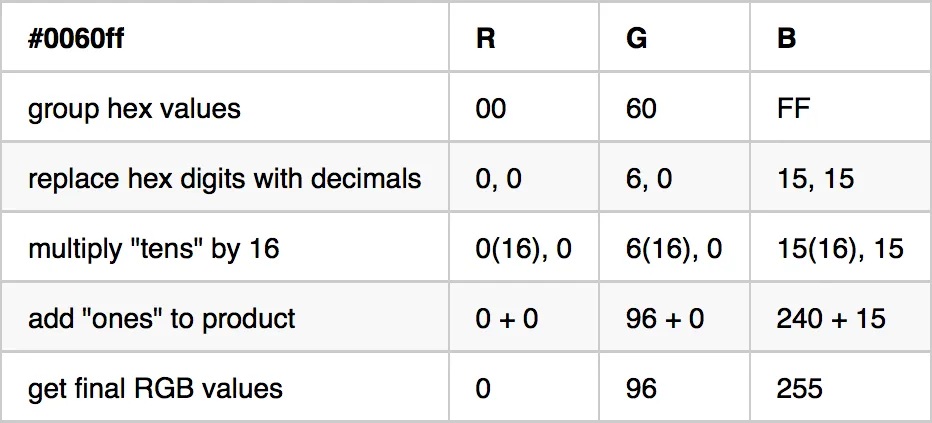
Converting #0060FF to RGB:
Conversion table for hexadecimal to decimal RGB
#0060FF = RGB(0,96,255)
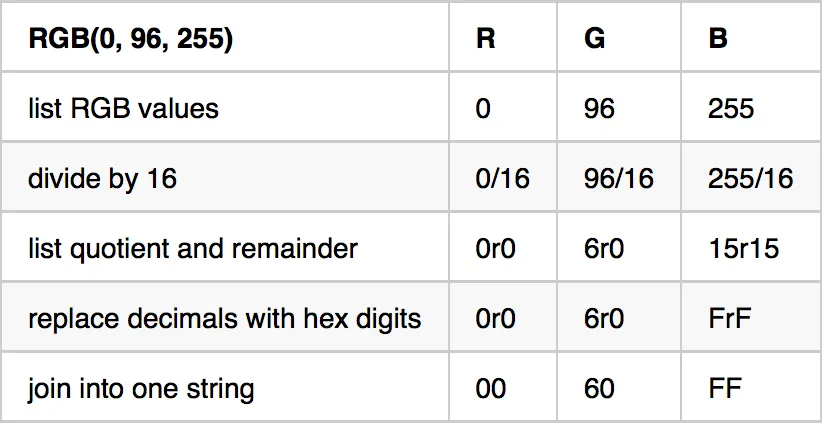
You can reverse this process by dividing (Euclidean division) your decimal RGB value by 16. The quotient goes in the “tens” place of the hex number and the remainder goes in the “ones” place.
Converting RGB(0,96,255) to hexadecimal:
Conversion table for decimal to hexadecimal RGB
RGB(0,96,255) = #0060FF
Approximating hexadecimal channel ratios
The mental math for exact hex conversions can be slow and confusing at first. The best way to develop an intuition for how hexadecimal RGB works is just to approximate: you’ll get sharper and sharper with time until it’s second nature. Here’s an easy approximation scheme:
1. Split the hex string into 3 groups of 2 characters just like you would for a conversion to decimal.
2. Round each channel’s value to the nearest 0.
If the second digit is 8 or above, round up (e.g. 3A rounds to 40); you can round high Fs to a theoretical G0
Otherwise round down (e.g. 37 rounds to 30)
Hexadecimal digits 8–F round up; 0–7 round down.
3. You now have a rough ratio for your channel mix: the first digit tells you approximately how many sixteenths of that color you’ve added.
For example: #873AFF rounds to 80 | 40 | G0. 8/16 red, 4/16 green, and 16/16 blue gives us an approximate 2:1:4 RGB ratio.
Remember when we added green by 1/8 increments to our first blue swatches? 1/8 = 2/16; you can clearly see us adding 2/16 of green each time the first digit in the green channel’s hex number increases by 2.
Each time the first digit in the green channel’s hex number increases by 2, it’s like adding 2/16 of green.
You’re in good shape when you get to the point where you can look at #0060FF and quickly tell that it’s full blue with some green mixed in (a little less than half the channel).
Using our estimation technique from above, we can quickly see 6/16 green and 16/16 blue which simplifies to “3 parts green, 8 parts blue.” At this point, you’re seeing hexadecimal RGB color like a painter sees a palette.
So there you have it, a primer for getting started with mixing in RGB. To recap, some of the advantages of mixing in RGB are:
The ability to create more organic color relationships using channel ratios
The opportunity to arrive at color palettes using a system that encourages discretionary relationships (much like the grid does for layouts)
The congruence of building color palettes using the parameters of the color space itself as mixing model
Not having to worry about the sometimes arbitrary effects of saturation and brightness on different hues or the 360º of the color wheel
The convenience of developing an understanding of working with hexadecimal RGB color